Industrial AI Cloud Opens In Munich
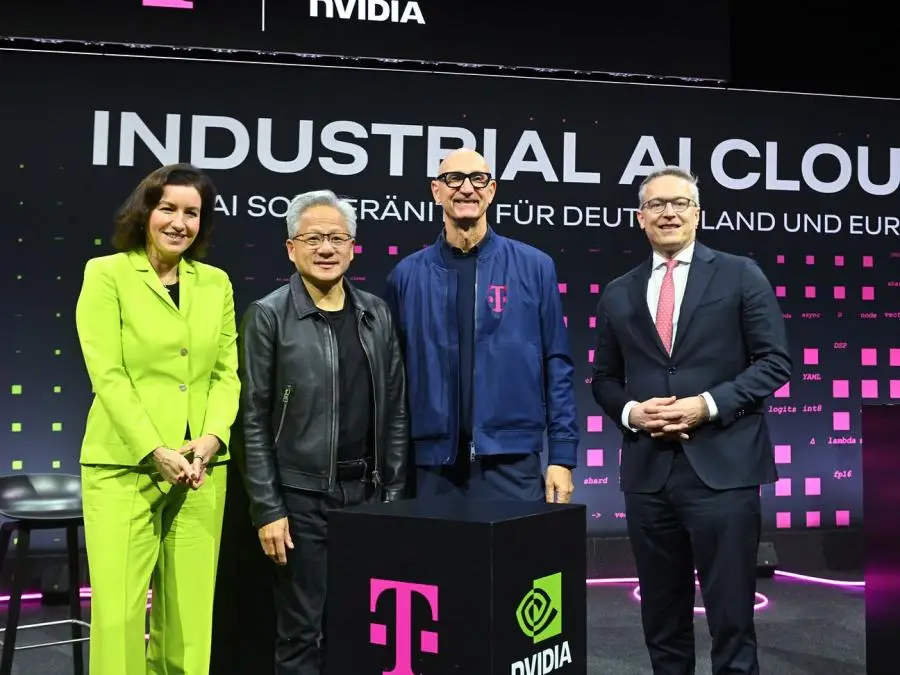
Germany officially opened its first large-scale AI factory in Munich. The facility is called the Industrial AI Cloud. It ranks among the most powerful computing centers in Europe.
Deutsche Telekom, NVIDIA, and Polarise collaborated on the project. Construction was completed in approximately six months. The launch signals acceleration in Europe’s artificial intelligence ambitions.
Source: UKTIN/Website
Europe Wants Digital Sovereignty
The European Union seeks to reduce dependence on foreign cloud providers. Policymakers increasingly emphasize strategic control over critical digital infrastructure. Artificial intelligence capabilities form a central pillar of this strategy.
German leaders presented the facility as proof of European capability. Tim Höttges, CEO of Deutsche Telekom, underscored technological independence. Officials described the investment as a sovereignty milestone.
Nearly 10,000 GPUs Power The Facility
The AI factory operates with nearly 10,000 NVIDIA Blackwell GPUs. It delivers up to 0.5 exaFLOPS of computing performance. That scale positions it among Europe’s largest AI infrastructures.
Telekom stated the capacity could theoretically serve 450 million EU citizens simultaneously. High-performance computing supports industrial research and public sector applications. The system is optimized for demanding industrial workloads.
Recommended Article: Nvidia OpenAI Investment Talks Stall Amid Strategic Doubts
Strict EU Data Rules Govern Operations
A primary objective is maintaining data within European jurisdiction. The infrastructure complies with EU and German data protection regulations. Sovereign governance distinguishes it from foreign hyperscale providers.
Digital sovereignty remains central in global technology competition. Officials argue sensitive industrial data should stay in Europe. Regulatory compliance strengthens institutional trust.
Deutschland Stack Integrates Business Software
The project highlights the Deutschland stack initiative. Developed with SAP, it integrates AI tools, cloud infrastructure, and enterprise software. The platform serves both corporate and government users.
Combining infrastructure and applications reduces system fragmentation. Companies can deploy AI within a unified environment. Policymakers view integration as essential for competitiveness.
Early Adoption Driven By Industrial Partnerships
Siemens is integrating components of its SIMCenter simulation portfolio. Executives report substantial reductions in simulation processing time. Industrial use cases underpin the factory’s business model.
Around ten companies have already joined the ecosystem. Early partnerships confirm operational readiness. Industry demand reinforces long-term scalability prospects.
Renewable Energy Supports Sustainable Operations
The facility operates entirely on renewable energy sources. River water cooling systems enhance environmental efficiency. Waste heat will supply surrounding areas in Munich.
Sustainability aligns with European climate objectives. Expanding industrial AI requires balancing performance with decarbonization goals. The factory represents both digital advancement and environmental strategy.