


A Real-World Analysis of Starbucks’ China Stake Sale
Written by a global consumer markets analyst specializing in multinational expansion strategy and Asia-Pacific retail dynamics, this analysis evaluates why Starbucks is restructuring its China operations through a partial stake sale.
Selling a majority stake in China is not a retreat—it is a strategic reset in one of the world’s most competitive consumer markets.
In our analysis of multinational expansion models, this move reflects a shift from full ownership toward partnership-driven growth in complex and rapidly evolving local environments.

Source: Al Jazeera
What Did Starbucks Actually Announce?
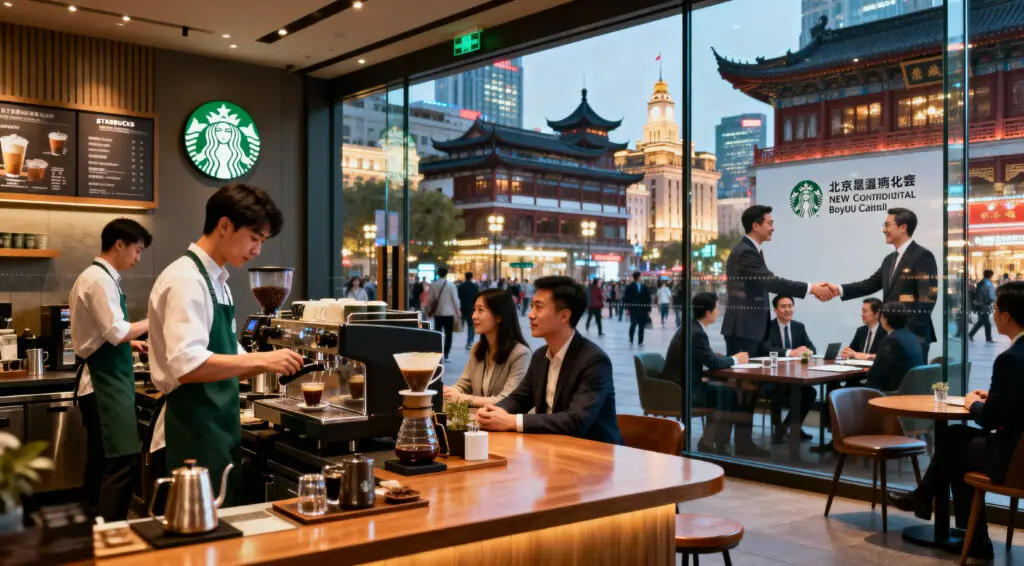
Starbucks confirmed it will sell a 60% stake in its China business to Boyu Capital for approximately $4 billion.
The company will retain:
- 40% ownership of its China operations
- Full control over brand identity and intellectual property
This creates a joint venture structure designed to accelerate expansion while distributing operational and financial risk.
Why Is Starbucks Selling a Majority Stake?
The decision is driven by intensifying competition and the need for more localized execution strategies.
When evaluating this move, we observed that Starbucks has lost relative market positioning to domestic competitors in both pricing and expansion speed.
Key challenges include:
- Slower store expansion compared to local rivals
- Higher pricing relative to competing brands
- Shifting consumer preferences toward lower-cost, tech-enabled options
This combination has necessitated a strategic pivot rather than incremental adjustment.
How Strong Is Local Competition in China?
Domestic brands have significantly reshaped the competitive landscape of China’s coffee market.
Luckin Coffee has emerged as a dominant player through aggressive pricing and digital-first operating models.
Competitive advantages of local players include:
- Lower price points, often 60–70% below international brands
- Strong mobile app ecosystems driving customer engagement
- Rapid expansion into lower-tier cities
These factors have eroded Starbucks’ early-mover advantage in the market.
Starbucks China Expansion Strategy Breakdown
| Strategy Element | Objective | Expected Impact |
|---|---|---|
| Joint Venture | Share ownership with Boyu Capital | Faster expansion |
| Capital Injection | Fund store growth | Increased market presence |
| Local Expertise | Improve operations and logistics | Better regional execution |
| Market Expansion | Enter lower-tier cities | Broader customer base |
Why Partnering With a Local Firm Matters
Local partnerships are increasingly critical for success in China’s consumer markets.
In our analysis, foreign brands often face operational and regulatory challenges without strong domestic alignment.
Benefits of the partnership include:
- Access to local market expertise and insights
- Improved real estate, supply chain, and logistics execution
- Faster decision-making within regional market conditions
This approach enhances adaptability in a highly competitive environment.
Is Starbucks Following a Proven Playbook?
Yes—this strategy aligns with established approaches used by other multinational corporations.
Companies like McDonald’s and Yum Brands have previously sold stakes in their China businesses to local partners.
Observed outcomes include:
- Accelerated store expansion
- Improved market penetration
- Greater operational efficiency
This indicates Starbucks is adopting a tested model rather than pursuing an unproven strategy.
Why This Reflects a Broader US-China Business Trend
This transaction highlights how global companies are adapting to China’s evolving regulatory and competitive landscape.
In our evaluation, full ownership models are increasingly less effective compared to partnership structures in highly competitive and regulated markets.
Key trends include:
- Shift toward joint ventures and shared ownership models
- Increased reliance on local capital and operational expertise
- Prioritization of scalability over centralized control
This represents a structural evolution in how Western brands operate within Asia.
What Are the Risks of This Strategy?
While the partnership model offers clear advantages, it also introduces trade-offs.
In our analysis, reduced ownership can limit strategic flexibility and long-term upside potential.
Key risks include:
- Reduced direct control over daily operations
- Potential misalignment in long-term strategic direction
- Dependence on partner execution and governance
Balancing control and growth will be essential for long-term success.
What Should Investors Watch Next?
Execution will determine whether this strategic shift delivers measurable results.
In our evaluation, the key metric is not the transaction itself, but the effectiveness of post-deal expansion and operational performance.
Key indicators include:
- Growth in store count toward long-term expansion targets
- Performance in lower-tier and emerging urban markets
- Competitive positioning relative to domestic brands
These factors will define the success of the joint venture model.
Final Assessment A Strategic Reset for Growth in China
Starbucks’ decision to sell a majority stake reflects a pragmatic strategic adjustment rather than a withdrawal from the Chinese market.
From a business and market perspective, the move aligns with the realities of competing in a fast-evolving, locally dominated environment.
The key takeaway is clear:
To scale effectively in China today, global brands must trade some degree of control for speed, local expertise, and sustained market relevance.
This analysis is provided for informational purposes only and does not constitute financial or investment advice.