


Sports Tech Hook Innovation Drives Competitive Edge
In our analysis of the global sportswear market, Nike is doubling down on innovation to maintain its competitive edge and accelerate product development.
The company’s latest restructuring signals a shift toward faster, athlete-centered design and deeper technology integration.

What Nike Is Changing
The company is restructuring its core operations.
Key move:
- объединение Innovation, Design, and Product teams
- Integration across Nike, Jordan Brand, and Converse
- Creation of a single athlete-focused innovation engine
This aims to streamline development and improve collaboration across divisions.
Why The Strategy Matters
Nike is focusing on speed and efficiency in product creation.
Core objectives:
- Faster innovation cycles
- Better sharing of technology and insights
- Stronger alignment with athlete needs
In our evaluation, this positions Nike to respond more quickly to shifting consumer and performance trends.
New Innovation Platforms Unveiled
Nike introduced several advanced product initiatives.
Key platforms:
- Aero-FIT – enhanced cooling technology
- Nike Mind – neuroscience-based footwear
- Project Amplify – powered performance footwear
- Therma-FIT Air Milano – adaptive temperature apparel
These innovations reflect a broader push into performance-driven technology.
Athlete-Centered Design Approach
The strategy emphasizes direct athlete involvement.
Key focus:
- Understanding real-world performance needs
- Designing solutions based on athlete feedback
- Enhancing both elite and everyday performance
This reinforces Nike’s long-standing athlete-first philosophy.
Nike Innovation Ecosystem Breakdown
| Component | Function | Strategic Impact |
|---|---|---|
| Research Labs | Performance testing | Data-driven design |
| Athlete Input | Real-world feedback | Product relevance |
| Cross-Brand Integration | Shared expertise | Faster development |
| Technology Platforms | Product innovation | Competitive edge |
| Design Teams | Execution and iteration | Speed to market |
This integrated system allows Nike to compress development timelines while maintaining product quality.
Investment In Research And Development
Nike’s innovation is supported by major infrastructure.
Key assets include:
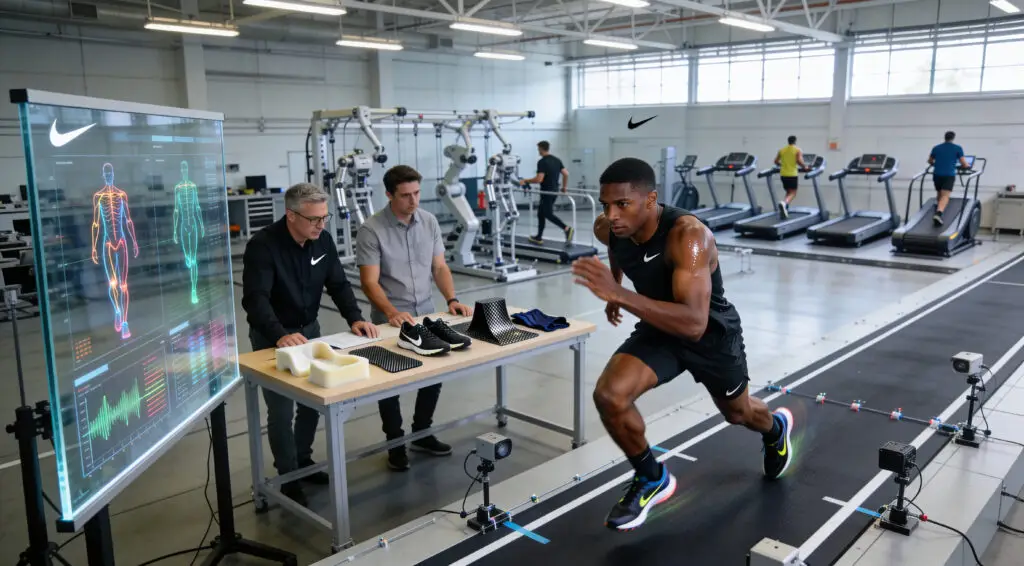
- Nike Sport Research Lab
- LeBron James Innovation Center
- Serena Williams Building
These facilities enable advanced testing, biomechanics research, and rapid prototyping.
Collaboration Across Brands
The integration spans multiple Nike-owned brands.
Key benefits:
- Shared expertise between Nike, Jordan, and Converse
- Unified development processes
- Reduced duplication of effort
This creates stronger synergy across the portfolio.
Competitive Pressure In Sportswear Market
The move comes amid rising competition.
Key challenges:
- Increased innovation from global rivals
- Growing demand for performance-driven products
- Need for constant differentiation
In our analysis, speed of innovation is becoming a primary competitive advantage.
Growth Strategy Through Innovation
Nike is linking product development directly to revenue growth.
Key drivers:
- Launch of technology-focused product lines
- Expansion into new performance categories
- Stronger engagement with athletes and consumers
Innovation is positioned as a central growth engine.
Outlook Faster Innovation Cycles Ahead
The unified structure is expected to accelerate product launches and improve responsiveness to market demand.
Short-term gains may include stronger product pipelines and improved competitive positioning.
Innovation As A Long-Term Advantage
Nike’s strategy reflects a broader industry shift.
From a market perspective, success increasingly depends on how quickly companies convert ideas into high-performance products. Execution speed, integration, and athlete-focused design will define leadership in the next phase of the global sportswear market.