


Pentagon Appoints New Chief for AI and Digital Strategy
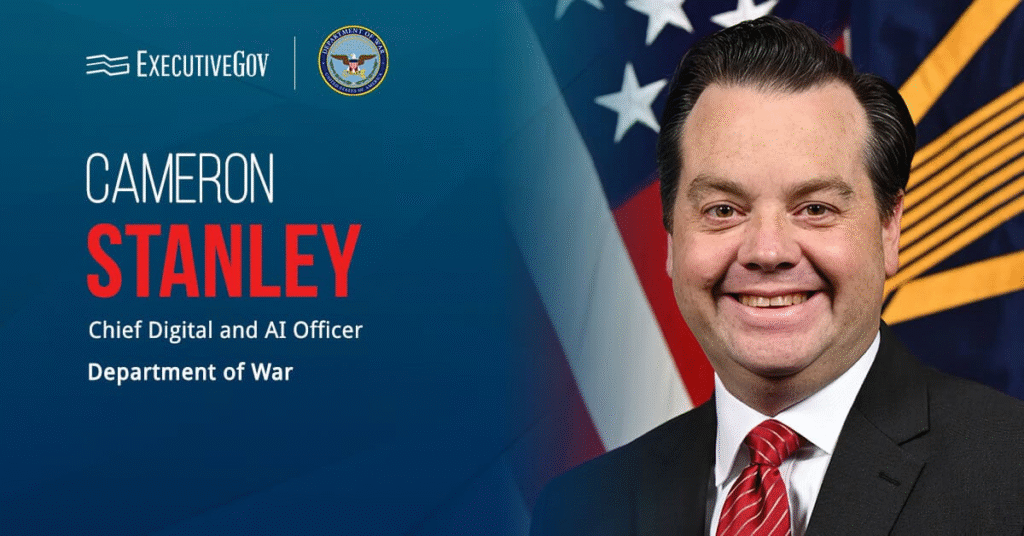
The War Department has chosen Cameron Stanley to be the next Chief Digital and Artificial Intelligence Officer. Pete Hegseth, the Secretary of War, made the announcement during a speech at SpaceX’s Texas headquarters. Stanley, a veteran of the Air Force with a lot of experience in the private sector, will be in charge of the department’s AI and digital modernization projects.
Hegseth stressed how important Stanley’s leadership will be in reaching the AI goals set by President Donald Trump’s executive order. The appointment shows a renewed commitment to using cutting-edge AI systems in defense operations. The secretary said that Stanley’s team was a “magnet” for top-notch technical talent who wanted to help make national security better.
Source: ExecutiveGov
Speed and Agility Define New AI Deployment Goals
Hegseth said that speed was the most important measure of success for the new AI programs. He told Stanley’s team to come up with deployment velocity benchmarks within 30 days and to give monthly updates on how things were going. These performance standards will affect when AI will be used in all branches of the military in the future.
“Speed wins; speed rules,” Hegseth said that the department will get rid of bureaucratic inertia in order to speed up deployment. The War Department wants to make sure that AI capabilities are ready for use faster than those of other major world powers. Key performance indicators will be how well things are done and how quickly they are done.
Barrier Removal Team Aims to Speed Up Bureaucratic Delays
Hegseth has set up a “barrier removal SWAT team” in the Office of the Undersecretary for Research and Engineering to speed up progress. This unit can ignore rules that aren’t in the law and go straight to senior leadership with delays. The team’s job is to get rid of procedural roadblocks that are making it hard to use AI.
Hegseth said that old rules about sharing data, making contracts, and testing would now be seen as operational risks. “We are blowing up these barriers,” he said, calling the project a wartime way to change the way we use technology. The reform shows that systems that are slow to comply are moving toward faster execution.
Recommended Article: AMD Refreshes Ryzen AI Chips to Challenge Intel and Nvidia AI
Expanding AI Infrastructure and Computing Power
Building secure computing capacity on military bases is a big part of the War Department’s AI plan. Hegseth said that the Department of Energy will help build new data centers. The goal is to make sure that the military has control over the high-performance computers that AI needs to work.
He said, “We will spend a lot of money on making it easier for us to use AI computing power, from data centers to the tactical edge.” The initiative will also use money from the private sector to improve infrastructure. To speed up deployment, the company is thinking about working with some of the biggest tech companies.
Recruitment Drive to Strengthen AI Workforce
The department plans to hire more people under President Trump’s “Tech Force” program to keep innovation going. The goal of the effort is to bring in top engineers, data scientists, and AI researchers from both schools and businesses. Hegseth said that new hiring rules will make it easier and faster to find and hire technical experts.
He said, “We need to get the best people in the world to help us with this.” The larger workforce will work on AI engineering, cybersecurity, and digital transformation that is focused on a mission. Officials think that this influx of skilled workers will speed up progress on AI projects that are both classified and unclassified.
Redefining Responsible AI for Defense Operations
Hegseth said that “responsible AI” in the War Department would put mission effectiveness ahead of social or ideological concerns. He said that the department’s main goal will still be to make AI systems that are “truthful, secure, and lawful” and work well in combat situations. He said, “The days of fair AI and social justice are over.”
This directive is a big change from past ethical frameworks that stressed fairness and openness. The main things that AI models will be judged on under the new policy are how accurate they are, how well they follow the rules, and how reliable they are in the real world. The department says that its systems must be able to help with real-world warfighting goals without any political interference.
Unlocking Military Data for AI Integration
Hegseth also talked about a big plan to combine and free up military data so that AI can analyze it. Within 30 days, each branch of the military must send in a full list of all the data assets it has. The Chief Digital and AI Office will get these datasets, which include intelligence sources, to speed up the process of putting them all together.
Hegseth said, “Data hoarding is now a risk to national security.” The department wants to use decades of operational data to make predictive modeling and decision-making better. The U.S. military will have an unprecedented analytical edge in global defense readiness by making information that was previously kept secret available to everyone.
Growing the GenAI Platform Across Defense Networks
The War Department will also add to its GenAI.mil platform, which is where the government version of Google’s Gemini model is now hosted. Hegseth said that Elon Musk’s Grok AI from xAI will soon be added to the system. This will give defense applications new generative capabilities. The update will be available on all networks, both classified and unclassified.
He said, “We will have the best AI models in the world on every network in our department.” The goal of the integration is to improve automation, intelligence analysis, and operational efficiency at all levels of command. The War Department wants to solidify its position as the world leader in defense-related artificial intelligence with these new developments.