


Abhisit Gets Ready to Make a Political Comeback
Abhisit Vejjajiva, a former leader of Thailand, said he wants to have an impact on the next government after the national elections. He said that his return would help stabilize Thailand’s broken political system by promoting clean politics and institutional reform.
After years of political unrest and unstable leadership, Abhisit stressed the importance of rebuilding public trust. He said that Thailand needs leaders who are honest and can fight corruption while fixing problems with the way the government works.
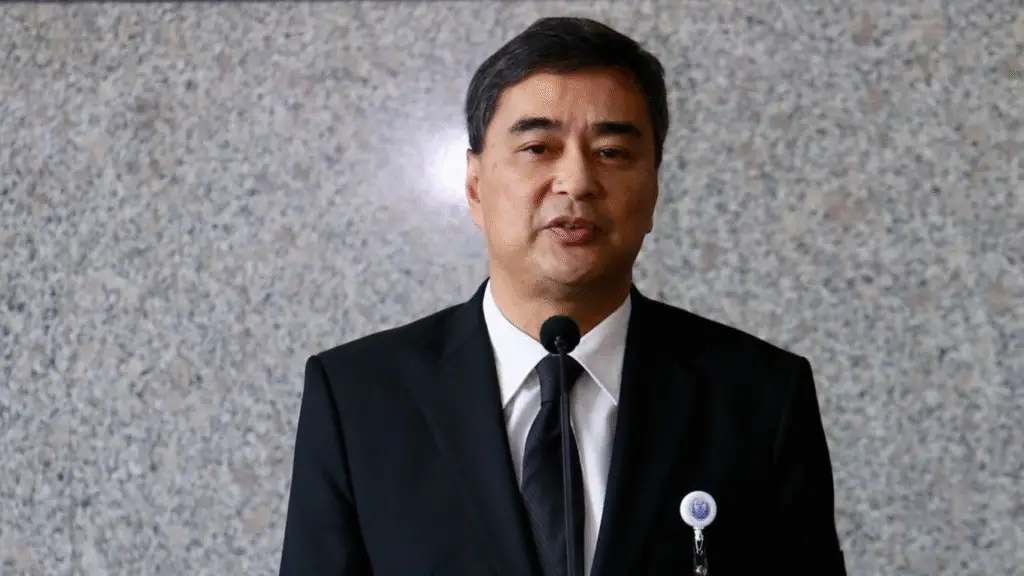
Source: Thai PBS World/Website
Democrat Party Poised as Coalition Power Broker
After the elections in February, Abhisit’s Democrat Party is expected to become the 4th largest party in parliament. That position gives the party an advantage in coalition talks, since no one group is likely to get a majority.
Polls show that the House of Representatives is very divided after the vote. In this situation, midsize parties like the Democrats become important kingmakers when it comes to forming a government.
Clean Politics Central to Abhisit’s Campaign Message
Abhisit has pushed for an agenda that focuses on clean politics and high standards of ethical governance. He compared his platform to recent scandals that led to the removal of leaders in a short amount of time.
In just over 1 year, Thailand has had to remove 2 leaders for breaking ethical rules. Abhisit said that voters want honesty as much as they want the economy to get better.
Recommended Article: Thailand Tightens Oversight of Cash Inflows to Protect Baht
Anti Scam Crackdown Forms Key Policy Pillar
One of the main goals of Abhisit’s platform is to shut down cyber scams that target Thai citizens and people from other countries. He said that scam networks are deeply rooted criminal businesses that hurt the credibility and safety of the country.
Thailand has come under international criticism for allowing scam compounds to operate inside and near its borders. Abhisit said that taking strong action could bring back trust in investors and the region.
Economic Recovery Tied to Political Stability
Abhisit said that Thailand’s slow economic growth was directly related to its political stability. He said that ongoing instability would keep the economy from growing and make people less likely to invest in the country.
Changes in leadership and uncertainty about policies have made it hard for Thailand’s economy to get back on track. Abhisit said that a stable coalition is necessary for long-term growth.
Experience From Turbulent Prime Ministerial Tenure
Abhisit was prime minister from 2008 to 2011, when there was a lot of unrest in the country. He said that time gave him important experience dealing with political division and institutional pressure.
There were big protests and the military got involved in politics while he was in office. Abhisit said that those challenges helped him understand compromise and how to be strong in government.
Election Outcome Likely to Reshape Thai Politics
People think that the February election will lead to a complicated coalition government. Abhisit thinks his party can bring together people from different political groups.
He said that his job would be to make sure the government worked, not to get more power for himself. That position backs up his claim that he is a stabilizing kingmaker.