



NTU Starts a New Phase in Singapore’s Space Goals
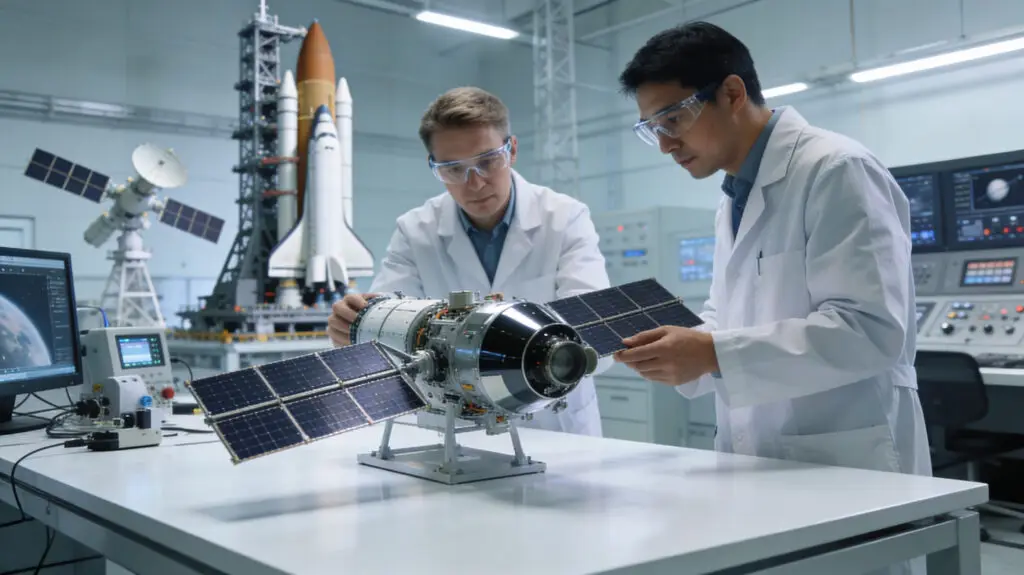
To speed up the commercialization of technology, Nanyang Technological University is starting 3 advanced space projects as part of Singapore’s Space Technology Development Program. The project is part of a national effort to speed up development times and test new ideas directly in space. Researchers want to make Singapore a stronger player in the global space economy.
The projects are all about AI, propulsion, materials science, and technologies for observing Earth. Each mission is planned so that it can be quickly set up with smaller satellite platforms. Together, they show that space operations will become more flexible and less expensive.
Source: TechNode Global/Website
Satellite with AI Brings Computing to Space
One project has a nanosatellite with edge-computing AI that can process data right in space. The satellite doesn’t send raw images to Earth; instead, it uses small AI models to look at images on board. This method speeds up decision-making and lowers bandwidth needs.
The Satellite Research Center at NTU made the satellite, and Satoro Space built the platform that it will be used on. The nanosatellite is based on a 3U CubeSat design that is best for quick testing and deployment. It is a big step forward for AI-powered satellite operations.
Testing Next-Generation Perovskite Solar Cells
The AI satellite will also test lightweight perovskite solar panels in space. These new cells promise to be more efficient and lighter than older solar technologies. Before they can be used by more businesses, they need to be tested in space.
NTU researchers and the local startup Singfilm worked together to make the solar panels. We will keep an eye on how well they work in real space radiation and heat. Success could make it much easier for small satellites to generate power.
Recommended Article: Apple Taps Facial Recognition to Decode Human Body Cues Tech
The Space Access Program Makes Launch Cycles Faster
The Space Access Program, which is part of Singapore’s national space strategy, is helping with these 3 missions. The Office for Space Technology & Industry runs the program, which aims to launch once a year until 2028. It wants to make it easier to experiment in space.
The program lowers costs and speeds up research by giving researchers structured access to launch opportunities. Local businesses can test out new technologies without having to wait years for missions. This model speeds up innovation throughout the space ecosystem.
Advanced Propulsion Enables Satellite Maneuverability
A second project will send up a bigger nanosatellite that can do complicated orbital maneuvers. The satellite will have a multi-stage electric propulsion engine that is made to control thrust well. In crowded low Earth orbit, this kind of mobility is becoming more and more important.
NTU spin-off Aliena made the propulsion system, which uses electric and magnetic fields to speed up ionized gas. This lets you raise and lower the orbit with very little fuel use. The technology makes it possible for satellites to work in a way that is good for the environment.
Researching the Durability of Materials in Harsh Orbits
The satellite that can move will also have an Atomic Oxygen Detector made by NTU Temasek Laboratories. Atomic oxygen is very corrosive and can seriously damage materials on spacecraft. It is very important for satellites in very low Earth orbit to study its effects.
Engineers will be able to make materials that last longer thanks to the detector’s data. Better durability lowers the risks of needing repairs and makes satellites last longer. These ideas help make long-term space operations safer.
Imaging Payload Tested on the International Space Station
The third project will put a high-resolution electro-optical imaging payload on the International Space Station to the test. The payload, called LEOCAM, has a special optical design with 3 mirrors. This setup makes it possible to get sharper pictures of Earth.
LEOCAM, which was made by the Singapore company LightHaus Photonics, is meant to take pictures of small details on the ground from space. In-orbit validation is an important step toward making the technology available to the public. The test is a big step forward for Singapore’s optical space technology industry.