A Real-World Analysis of the US Affordability Crisis
Written by a consumer economics analyst specializing in retail trends, household spending behavior, and macroeconomic conditions, this analysis examines why more Americans are shifting toward discount grocery retailers.
The U.S. economy continues to grow at a macro level, but many households are experiencing increasing financial strain.
In our analysis of consumer behavior patterns, rising living costs are forcing even middle- and high-income households to adjust spending habits in ways typically associated with economic downturns.
Why Are More Americans Shopping at Aldi?
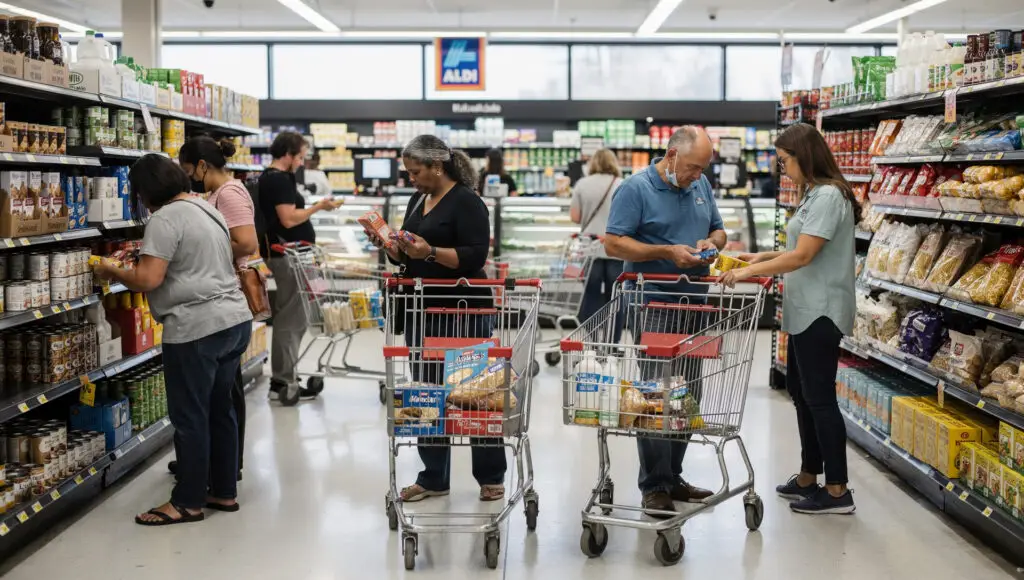
Discount retailers are no longer viewed as fallback options—they are becoming primary shopping destinations.
Aldi has experienced increased foot traffic as consumers prioritize essential spending over discretionary purchases.
Key behavior shifts include:
- Switching to lower-cost grocery stores
- Reducing purchases of higher-priced items such as beef
- Cutting back on dining out and non-essential expenses
This reflects a broader transition toward value-driven consumption.
Source: ALDI Corporate
What Is Driving the Affordability Crisis?
Multiple cost pressures are converging simultaneously across the economy.
When evaluating economic data, we observed that inflation alone does not fully explain the strain—structural costs are rising across multiple categories.
Core drivers include:
- Persistent inflation in food, housing, and essential goods
- High interest rates affecting borrowing and credit access
- Rising energy and utility expenses
- Price pressures linked to trade policies and tariffs
These factors are compounding rather than acting independently.
How Is Consumer Behavior Changing Across Income Levels?
The impact of rising costs is no longer limited to lower-income households.
In our analysis, even households earning six-figure incomes are adjusting spending patterns, signaling a deeper structural shift.
Observed changes include:
- Reduced discretionary spending on non-essential items
- Delayed major lifestyle purchases such as travel or home upgrades
- Increased prioritization of essential goods and services
This indicates a broad-based behavioral shift across income tiers.
US Consumer Spending Shift by Income Tier
| Income Tier | Spending Behavior | Economic Impact |
|---|---|---|
| High Income | Continued strong spending | Supports overall growth |
| Middle Income | Reduced discretionary spending | Slows retail sectors |
| Low Income | Focus on essentials only | Increased financial strain |
What Is a K-Shaped Economy and Why Does It Matter?
Economists describe the current economic environment as a “K-shaped” recovery or expansion.
In this model, higher-income households continue to accumulate wealth, while lower- and middle-income groups experience stagnation or decline.
Key implications include:
- Uneven distribution of economic gains across society
- Increased reliance on spending by higher-income consumers
- Greater vulnerability to economic shocks in lower tiers
This dynamic creates long-term instability despite strong headline economic indicators.
How Are Rising Costs Affecting Daily Life?
The affordability crisis is most visible in everyday household expenses.
In our evaluation, rising costs are forcing households to make trade-offs between essential needs and discretionary wants.
Examples include:
- Higher grocery and utility bills
- Increased costs for home heating and transportation
- Reduced spending on dining, travel, and leisure activities
Even small price increases can have significant cumulative effects over time.
Why Discount Retailers Are Benefiting
Retailers focused on low-cost offerings are gaining market share in the current environment.
Companies such as Walmart and Costco are also seeing increased demand alongside Aldi.
Competitive advantages include:
- Lower pricing structures supported by efficient operations
- Streamlined supply chains reducing overhead costs
- Focus on essential goods aligned with consumer priorities
These factors position discount retailers to benefit from ongoing economic pressure.
What Does This Mean for the US Economy in 2026?
The economy’s growing reliance on high-income spending introduces structural risks.
In our analysis, a slowdown among top earners could have disproportionate effects on overall economic performance.
Key risks include:
- Concentration of consumption among higher-income groups
- Weak demand across middle-income segments
- Increased sensitivity to recessionary pressures
This imbalance reduces the resilience of economic growth over time.
What Should Businesses and Investors Watch?
Consumer behavior is becoming a leading indicator of broader economic direction.
In our evaluation, the shift toward discount spending reflects caution rather than confidence among households.
Key indicators to monitor include:
- Retail performance across different pricing segments
- Trends in discretionary versus essential spending
- Wage growth relative to inflation
These signals will help define market conditions in the coming months.
A Structural Shift in Consumer Behavior
The rise of Aldi reflects more than cost-conscious shopping—it signals a deeper affordability challenge within the U.S. economy.
From a financial and market perspective, the divergence between income groups is becoming a defining feature of current economic conditions.
The key takeaway is clear:
As living costs continue to outpace income growth for many households, value-driven consumption is no longer temporary—it is becoming the new baseline.
This analysis is provided for informational purposes only and does not constitute financial or investment advice.