


OpenAI Unveils Self-Helping Coding Model
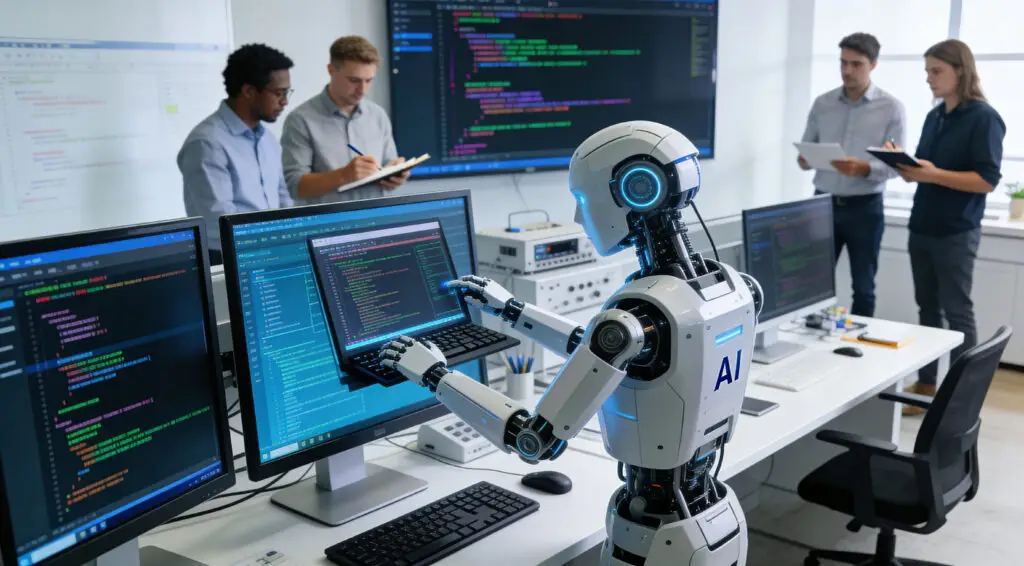
OpenAI announced that GPT-5.3-Codex represents a major technological milestone. The company stated that earlier internal versions supported its own development process. The system assisted in debugging training runs and monitoring deployment workflows.
In an internal blog post, OpenAI described how engineers relied on Codex. The model reportedly helped interpret evaluation outputs and test results. Leadership highlighted the acceleration in development speed.
Source: NBC News/Website
Coding Agents Transform Software Development
Codex functions as an AI-powered coding assistant. Users can generate complex software programs through natural language prompts. Line-by-line programming tasks are increasingly automated.
Developers now focus more on architectural design than manual syntax writing. Comparable tools include Claude Code and Cursor from Anthropic. Such systems are reshaping traditional programming workflows.
Feedback Loops Accelerate AI Development
OpenAI leaders say AI tools now assist in building subsequent models. This dynamic tightens feedback loops within research teams. Iterative improvement cycles have shortened considerably.
Internal researchers reportedly use Codex to monitor training runs continuously. The system evaluates datasets and reviews performance metrics. Automation enhances efficiency and productivity.
Recommended Article: Nvidia OpenAI Investment Talks Stall Amid Strategic Doubts
Performance Gains And Cybersecurity Focus
OpenAI reported that GPT-5.3-Codex operates roughly 25% faster. The company also claims improved efficiency with reduced computing demands. Performance benchmarks reportedly reached record levels.
The model has been described as particularly strong in cybersecurity applications. Internal risk assessments influenced that classification. Enhanced capability raises both defensive and security considerations.
Codex Desktop App Expands Accessibility
OpenAI recently launched a Codex desktop application. The software enables users to manage multiple autonomous coding agents simultaneously. Downloads reportedly exceed 500,000.
The interface is designed for both beginners and experienced developers. Natural language inputs simplify task coordination. Product teams note coding consumes a large share of daily workflows.
AI Blurs Lines Between Roles
OpenAI product leaders say engineering structures are evolving. Designers increasingly rely on AI tools to generate code directly. Traditional role boundaries are narrowing rapidly.
Executives report that advanced coding models accelerate prototyping cycles. Projects that once required extended development timelines now move quickly. Iteration speed continues to increase across departments.
Toward Recursive Self-Improvement
Industry observers describe this shift as early recursive self-improvement. AI systems capable of enhancing their own development could drastically reduce research timelines. Some analysts foresee accelerated intelligence growth across sectors.
OpenAI executives have publicly referenced ambitions for automated research agents. Competing firms such as Anthropic report similar internal experimentation. The era of self-improving AI appears to be approaching rapidly.