



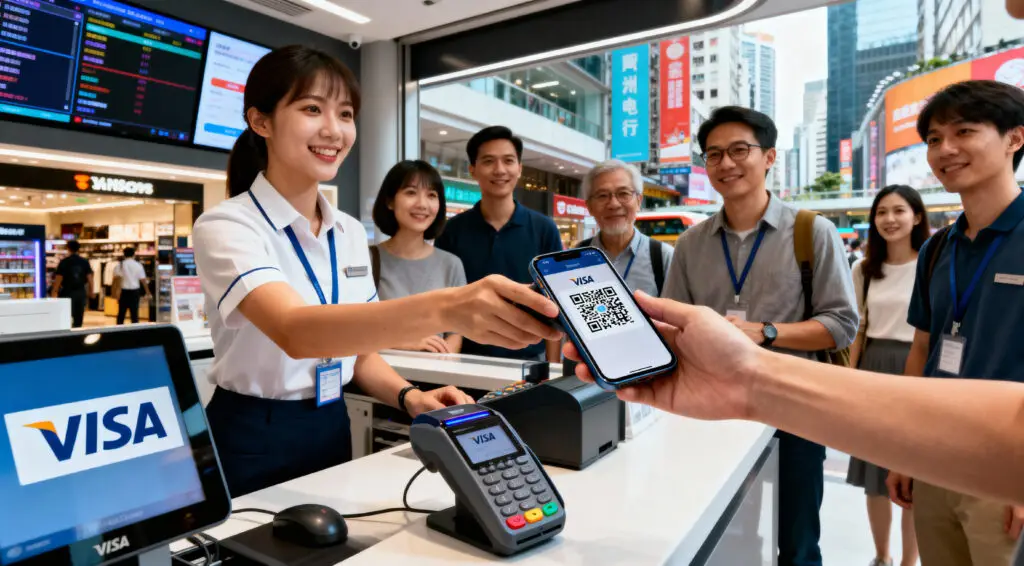
Visa’s Late Entry Into Asia’s QR Payment Revolution
Visa said on November 12 that it will start using Scan to Pay, a new QR-based payment method in the Asia Pacific region. The company’s efforts to catch up with regional payment trends are proof of its desire to do so, but observers wonder if the effort is too late to make a difference in a market now dominated by local giants like Alipay, WeChat Pay, GCash, and Paytm.
Visa works with wallets like Samsung Wallet, LINE Pay, VNPT Money, and others in eight regions, including Australia, Malaysia, Singapore, India, and Vietnam. But many who follow the market say that Visa’s late entry is more about adapting than coming up with new ideas in an area that started using QR payments years before foreign card networks did.

Visa Didn’t Remember This Technology Until Now
Visa’s statement makes a very clear point: QR payments grew quickly in Asia without Visa’s help. By the middle of the 2010s, Alipay and WeChat Pay had already changed the way people paid in China. In Southeast Asia, GrabPay, GCash, and Touch ‘n Go eWallet quickly became popular.
The new Scan to Pay technology links participant wallets to Visa’s global merchant network, making it possible to make payments in stores and online. T.R. Ramachandran, Visa’s Asia Pacific Head of Products, called the project “leading the way in speeding up QR adoption.” The story about the market, on the other hand, says that Visa is not leading but following, joining systems that customers have been using for almost ten years.
Missing Partners Show Visa’s Competitive Challenge
The relationships Visa got are more interesting for who isn’t there than for who is. Alipay, WeChat Pay, GrabPay, Paytm, and PhonePe, who are all important participants in the region and currently control QR-based transactions, are not on the list.
These businesses have created self-sufficient ecosystems that include payments, e-commerce, and loyalty programs. This makes it hard for them to work with Visa’s infrastructure. Visa’s partners, like Samsung Wallet and bank-issued cards, are really smaller or less competitive payment platforms that want to get more users. This pattern of partnerships shows that Visa doesn’t have much power in markets where it wasn’t an early inventor.
Recommended Article: Lenovo LPS Unveils Next-Gen IT Ecosystem With 18 Partners
Marketing Claims Meet Real-Life Questions
Visa’s press statement talks about perks, including more merchants accepting the card and easier payments across borders, but analysts are still not sure how much of an effect they will have. Most stores that accept Visa already take digital payments, so the new capability may just add QR capabilities without making the ecosystem bigger.
It also appears like the notion that it will be easier for overseas travelers is an exaggeration, because contactless Visa cards currently operate in much of Asia. Also, local businesses in countries like Thailand and Vietnam already utilize national QR systems like PromptPay and VNPay, so Visa doesn’t have much space to make things more cost-effective or get more people to use them.
QR Payment Ecosystems Have Already Solved the Problem
In contrast to Western markets, which slowly moved from cash to cards to contactless payments, many Asian customers jumped straight to QR-based solutions. Local wallets added payment features to everyday digital tasks, including shopping, paying bills, and getting rides.
Visa’s old business, which depended on card infrastructure and terminal technology, had a hard time staying relevant in this situation. Merchants set up their systems to function best with local QR schemes that handled more transactions for less money, ignoring worldwide card networks. Visa’s decision now looks like a smart move, an attempt to go along with, not change, how most people act.
A Defensive Strategy in a Market That Moved On
Visa’s Scan to Pay program is more of a defensive move than a breakthrough. Visa wants to get back access to transaction flows that don’t go via its network at all by embedding itself in current QR systems. Merchant economics, transaction costs, and user incentives are all things that the organization can’t control, but they will be important to its success.
Visa’s real problem isn’t how to technically build something; it’s how to make it relevant in the market. The company is seeking to go back into an area where local platforms have built up trust, convenience, and loyalty over time.
The Verdict: Adaptation, Not Innovation
Visa’s recent announcement highlights its effective catch-up strategy in an already established payment ecosystem. While the press release mentions “expanding acceptance” and “accelerating adoption,” the changes do not fundamentally alter payment methods in the area.
The success of Scan to Pay will hinge on measurable outcomes, including merchant participation and transaction volumes, as the initiative is viewed more as a relevance experiment rather than a groundbreaking change until substantial data is available. Although Visa remains active, the market dynamics have shifted, with new rules set by established players.