


Philips Grows Its Leadership in Therapy Guided by Images
Royal Philips said it will buy SpectraWAVE, a U.S.-based company that is a leader in AI-enhanced coronary imaging and diagnostics. The transaction gives Philips a bigger presence in cardiovascular intervention and makes its image-guided therapeutic ecosystem stronger.
This purchase fits with Philips’ goal of using cutting-edge hardware, software, and AI to enhance patient outcomes and operational accuracy in cardiac care.

AI-Powered Imaging and Physiology Tools from SpectraWAVE
Enhanced Vascular Imaging (EVI) and AI-powered angio-based physiology evaluations are two things that SpectraWAVE does well. These tests are very important for finding coronary artery disease. The HyperVue and X1-FFR systems are intended to be fast, accurate, and easy to use together.
These devices give real-time information about the coronary arteries from a single angiogram, which greatly speeds up the workflow and increases diagnostic confidence in percutaneous coronary procedures.
HyperVue Imaging System: DeepOCT and NIRS Integration
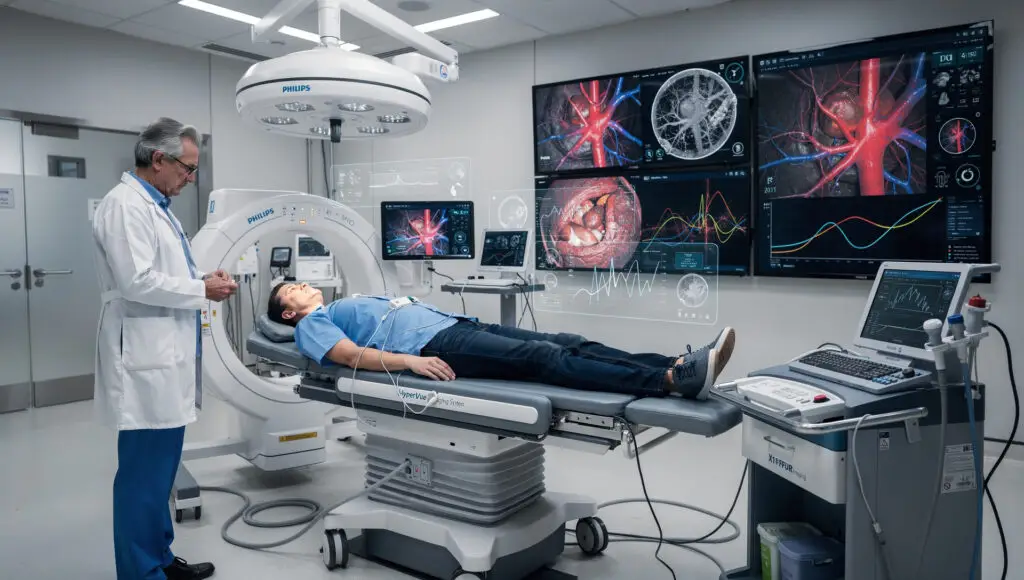
The HyperVue Imaging System uses Deep Optical Coherence Tomography (DeepOCT) and Near-Infrared Spectroscopy (NIRS) to show the coronary arteries in great detail. It takes high-definition pictures of the walls of arteries and the plaque inside them.
HyperVue’s AI-powered analysis lets doctors quickly check the health of arteries, and its smooth interaction with Philips’ Azurion and IntraSight systems makes it easy to utilize in busy hospitals.
Recommended Article: Fortnite Returns to Google Play After Major Legal Victory
X1-FFR Uses AI to Check the Health of Your Heart
SpectraWAVE’s X1-FFR technology gets Fractional Flow Reserve (FFR) straight from angiographic pictures; thus, there is no need for intrusive cables. The device turns X-rays into physiological data in a matter of seconds.
X1-FFR gives cardiologists noninvasive yet accurate ischemia evaluations when it is used with Philips’ OmniWire iFR toolbox. This makes physiologic advice more widely available.
Working with Philips’ Azurion Platform
Philips’ Azurion platform, which is the best in the business for image-guided treatment, will house SpectraWAVE’s technologies in its sophisticated workflow environment. The goal of the integration is to improve planning, guidance, and validation of procedures.
This collaboration establishes a single space for doctors, which improves accuracy, shortens treatment time, and improves results in cardiology, radiology, and vascular surgery.
Strategic Advantages for New Ideas in Heart Care
Philips CEO Roy Jakobs said that SpectraWAVE’s solutions support Philips’ long-term goal of making image-guided treatment available to everyone. The goal of the firm is to make minimally invasive heart operations safer and easier to do on a larger scale.
Philips’ purchase fits well with its AI efforts and supports its plan to provide data-driven, interoperable solutions for the burgeoning cardiovascular care industry.
Global Impact and Future Outlook
Coronary artery disease affects more than 300 million individuals throughout the world. Adding SpectraWAVE’s new technologies might make life-saving treatments much more widely available.
Philips is becoming a world leader in precision cardiology by merging imaging, AI, and interventional tools. This sets new benchmarks for how accurate clinical treatment is and how quickly patients may be treated.