




Crypto Market Cools After Strong Rally Period
The cryptocurrency market slowed down in February 2026 as prices fell after a long period of rising prices. Overall market capitalization fell along with asset prices, dropping by about 2.71% after last year’s rapid growth slowed down significantly. These kinds of pullbacks happen a lot after long rallies, and they usually show that people are taking profits and changing their expectations for the economy as a whole.
Investors are starting to see these changes as phases of consolidation instead of final reversals, especially when institutional participation stays the same. When markets cool down, they often reset leverage levels and build healthier foundations for the next growth cycle. But short-term sentiment tends to go down when volatility goes up.
BitMine Capitalizes on Lower Ethereum Prices
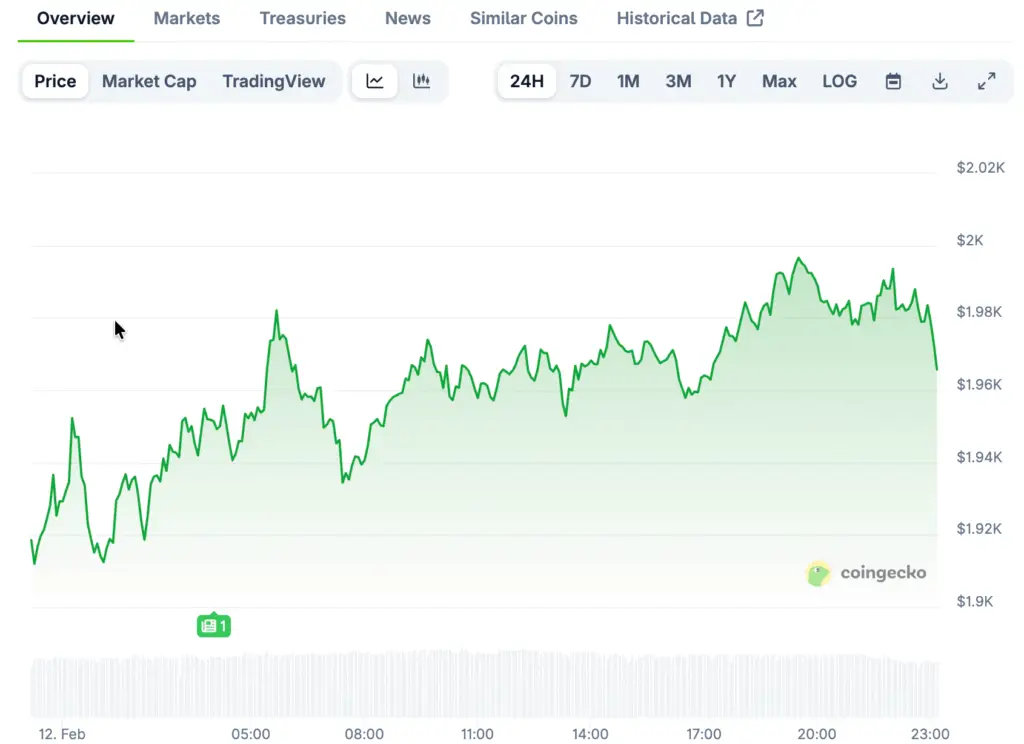
During the market downturn, Tom Lee’s investment firm BitMine used a large acquisition strategy to buy Ethereum at low prices. On February 11, the company purchased about 140,400 ETH worth roughly $282 million, which greatly increased its exposure. The move shows that there was a plan to buy during times when the market was thought to be inefficient.
Strategic buyers often see falling prices as opportunities instead of threats, especially when the long-term fundamentals stay the same. BitMine put itself in a strong position for possible recovery scenarios by acting quickly. This kind of timing can have a big effect on how well a portfolio performs over several years.
Total Staked Holdings Have a Value of Billions
After the most recent transaction, BitMine’s total staked Ethereum rose to almost 3 million ETH, which is worth more than $6 billion. This level of commitment puts the company in the same league as other major institutions that are actively supporting network security through staking. Big investments also show that Ethereum’s proof-of-stake system works well in practice.
Increasing staked balances shows a willingness to accept short-term liquidity constraints in order to earn rewards and stay aligned with the ecosystem. When institutions are confident that a protocol will be useful for a long time, they often take this stance. BitMine’s large holdings reinforce perceptions of Ethereum as a foundational layer of digital infrastructure.
Recommended Article: Ethereum Buy Signal Emerges After Massive Whale Accumulation
Long-Term Conviction Signals Institutional Buying
When the market is weak, aggressive accumulation often shows how strongly institutions believe that assets will appreciate in value in the future. BitMine’s purchases show that it believes Ethereum’s usefulness in decentralized finance and tokenization will keep growing around the world. People who watch the market usually see these kinds of moves as positive signs.
When sophisticated investors commit capital during uncertain conditions, it can help stabilize sentiment across broader trading communities. Sometimes, their participation leads to more inflows from participants seeking validation through institutional behavior. So, strategic buying can indirectly support market stability.
Staking Activity Tightens Available Ethereum Supply
About 69% of BitMine’s Ethereum is now locked up in staking contracts, which means that a large portion is no longer available for trading. When demand rises, especially during times of renewed market optimism, reduced supply can put upward pressure on prices. This dynamic often determines how prices will change over the next few months.
Supply constraints alone do not guarantee appreciation, but they often amplify directional moves once catalysts appear. As more tokens remain locked within validator frameworks, tradable inventory becomes less common. Because of this, traders keep a close eye on staking ratios as indicators of structural scarcity.
Accumulation Happened Close to Important Price Levels
BitMine is said to have bought more Ethereum in the days leading up to the staking initiative when prices approached $2,000. Buying near psychologically important levels suggests discipline and adherence to technical analysis frameworks commonly used by institutions. These kinds of entries can improve risk-adjusted return profiles.
Investors can benefit from targeting support zones, which helps limit downside risk compared to higher entry points. This planned approach contrasts with the reactive trading that often occurs during periods of market volatility. Over time, consistent accumulation strategies may outperform opportunistic speculation.
Strategic Move Highlights Ethereum’s Enduring Appeal
Even though the market as a whole is declining, BitMine’s actions show that confidence in Ethereum’s long-term technological and economic value remains intact. The network’s expanding use in smart contracts, tokenized assets, and digital finance strengthens its investment narrative. Institutions appear increasingly comfortable treating Ether as a strategic reserve asset.
Although short-term uncertainty persists, large commitments often signal expectations of future recovery. Market participants will likely monitor whether similar institutional flows emerge in the coming months. For now, BitMine’s investment stands as a clear example of conviction during a period of cyclical weakness.