




Bitcoin Drops As Markets React To Uncertainty About Rising Tariffs
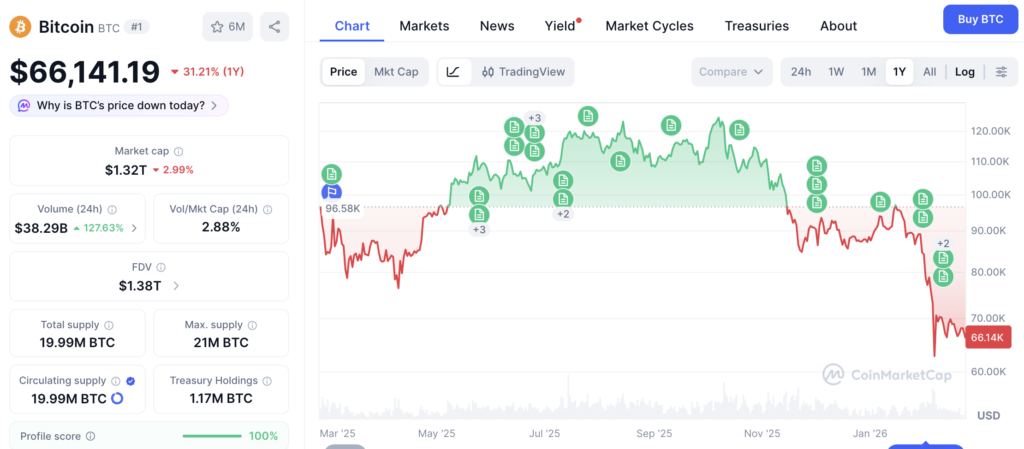
After tariff announcements caused more volatility, Bitcoin briefly fell below a key support level. The drop went down to intraday lows that were close to the early February price ranges for a short time. Markets saw more selling as traders changed their risk profiles in response to policy shocks.
The original cryptocurrency went up a little after the initial selling pressure eased. Investors were still cautious about stability near the important $65,000 level. Analysts noticed that people were more sensitive to changes in the economy that affected larger asset classes.
Crypto Market Faces Broad Declines During Risk Off Shift
Ethereum dropped more than five percent during the session. Other big digital assets also fell in value across all markets. Risk-off positioning was a big part of trading behavior in many different cryptocurrency segments.
During macro-driven responses, the connection between Bitcoin and altcoins grew stronger. After tariff talks got more heated, the mood on the market turned bad. Investors quickly changed their exposure to avoid bigger possible losses.
Tariff Hikes Cause Widespread Market Worry Around The World
When President Trump said he would raise global tariffs to 15%, people were even more worried. The move came after the Supreme Court threw out the old tariff authority frameworks. Combined developments added a lot of uncertainty to the outlook for global trade.
Risky assets, like cryptocurrencies, were hurt by this kind of policy instability. Traders kept an eye on news that could affect the stability of the global economy. More uncertainty made everyone, both institutions and individuals, more cautious.
Recommended Article: Bitcoin Stabilizes as Ethereum and XRP Diverge Today
Key Technical Levels Highlight Potential Downside Risk Zones
Analysts say that $65,000 is a key level of technical support. If this level is lost, selling could pick up speed very quickly. Possible drops could hit other support areas close to the larger $60,000 range.
If tariff disputes get worse, the market structure looks weak. Traders keep an eye out for confirmation signals that trend continuation patterns are still in place. Technical frameworks show that things become more fragile when macroeconomic pressures last for a long time.
Volatility Expected As Macro Factors Drive Crypto Sentiment
When tariffs are announced, they add more factors that affect how the market reacts in the short term. When there is uncertainty about the stability of the economy, crypto markets usually react quickly. During times of turmoil, the price behavior is greatly affected by the overall state of the economy.
Analysts think that prices will keep changing until there is more information about how tariffs will be enforced. Investors look at hedging strategies to find the best way to limit their downside risk. Volatility is still high in major assets because macro signals are changing.
Investor Behavior Reflects Caution Amid Policy Driven Turbulence
Participants are increasingly taking conservative positions in portfolios around the world. Recent trading patterns show less leverage and more selective asset rotation. While the markets get used to changing policies, people are still on high alert.
Sentiment indicators show that people are less confident when there is uncertainty about tariffs. Right now, traders are more focused on keeping their capital safe than on making speculative bets. Stability in the larger economy is what makes the market strong.
Bitcoin Market Outlook Hinges On Upcoming Policy Developments
The outcome of tariff negotiations could have a big effect on future price direction. Clear policy guidance could ease the pressure and slowly bring back trust. On the other hand, long-running disputes could continue to have a big effect on the performance of cryptocurrencies.
Analysts keep a close eye on upcoming economic indicators that will affect how investors feel about the market as a whole. Changes in global trade and regulatory environments still affect Bitcoin. Market participants expect big changes as macro conditions continue to change.