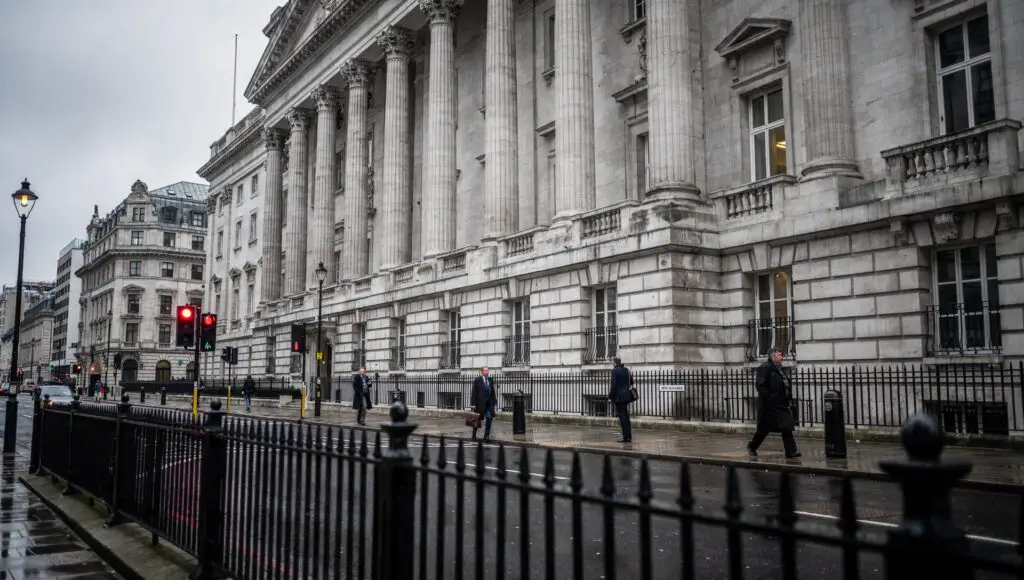
Bank Poised for Final 2025 Decision Amid Cooling Inflation
This Thursday, the Bank of England (BoE) is likely to say that interest rates will drop to 3.75%, the lowest level since February 2023. Economists think that the central bank’s Monetary Policy Committee (MPC) would lower the rate from 4% since inflation is falling down and the UK economy is also slowing down.
Analysts call this the “festive news for borrowers” decision since it would be the last policy decision of 2025 and consumers and companies are getting ready for the new year. The drop would be a big change after almost two years of restrictive monetary policy to keep inflation down following the outbreak.

UK Inflation Declines, Creating Space for Monetary Easing
The Office for National Statistics (ONS) recently reported that the Consumer Prices Index (CPI) inflation rate dropped to 3.6% in October, its lowest point in four months. The drop was mostly due to slower rises in the prices of gas and electricity, which gave customers some comfort after a lengthy period of rising costs of living.
The trend toward slower price increases has made arguments for monetary easing stronger. Economists say that the MPC can lower borrowing costs without worrying about prices rising again because inflation is decreasing, wage growth is slowing, and retail activity is slowing down.
Economists Welcome Relief but Warn Against Overoptimism
Most market observers concur with the Bank of England’s decision regarding interest rates while cautioning against expectations of rapid cutbacks. Laith Khalaf, an investment analyst at AJ Bell, indicated that the cut would please borrowers but emphasized that the bank remains focused on achieving its 2% inflation target.
He noted that while monetary policy may become less stringent, significant rate decreases are unlikely in the near future. Khalaf pointed out that previous easing policies will continue to affect the economy and that insufficient new stimulus may occur through 2026. His comments highlight a consensus on the Bank of England’s cautious approach in 2026 to prevent excessive economic stimulus.
Recommended Article: Taiwan and EU Expand Trade Cooperation via Investment Talks
Budget Measures Offer Limited Short-Term Impact
The UK’s fall budget, revealed by Chancellor Rachel Reeves, has influenced discussions on interest rates but adopted a neutral fiscal stance. Economist Philip Shaw noted that the budget’s impact will not be felt until 2028–29, making it less relevant to the current interest rate debate.
He pointed out that the freeze on income tax levels is negatively affecting consumer spending and the overall economy. This context of lower inflation and budgetary pressures supports the argument for a small rate decrease to stimulate economic growth into 2026.
Internal Divisions Within the Monetary Policy Committee
Despite expectations of a unanimous rate cut by the Bank of England’s MPC, opinions are divided. Andrew Goodwin, senior UK economist at Oxford Economics, predicts a cut is probable but indicates a significant dissent, with four out of nine officials likely opposing it, advocating for a wait until wage pressures decline.
The decision will heavily rely on Governor Andrew Bailey, who has recently expressed optimism regarding inflation forecasts. This forthcoming decision is anticipated to be one of the year’s most scrutinized monetary policy actions.
International Context: Following the Fed’s Lead
The Bank of England’s decision comes just after the US Federal Reserve announced its own rate decrease, which is the lowest level since 2022. This shows that the world is moving toward looser monetary conditions.
Jerome Powell, the head of the Federal Reserve, said that even though rates are lower currently, the central bank would still base its decisions on data and look at inflation and the job market before making any more cuts. The European Central Bank is likewise likely to stay cautious until early 2026.
BoE Faces Challenge Balancing Inflation Control with Economic Relief
If the rate cut is enacted, it will symbolize the conclusion of strict monetary tightening that began in 2021, potentially resulting in lower mortgage payments and cheaper loans for UK families, while businesses could benefit from improved financing conditions.
Economists caution that the Bank of England must balance inflation credibility with support for a weakening economy, avoiding premature optimism amid global market moderation. The decision could also influence Britain’s economic recovery trajectory in 2026.