


Deloitte And NVIDIA Bring Physical AI To The World
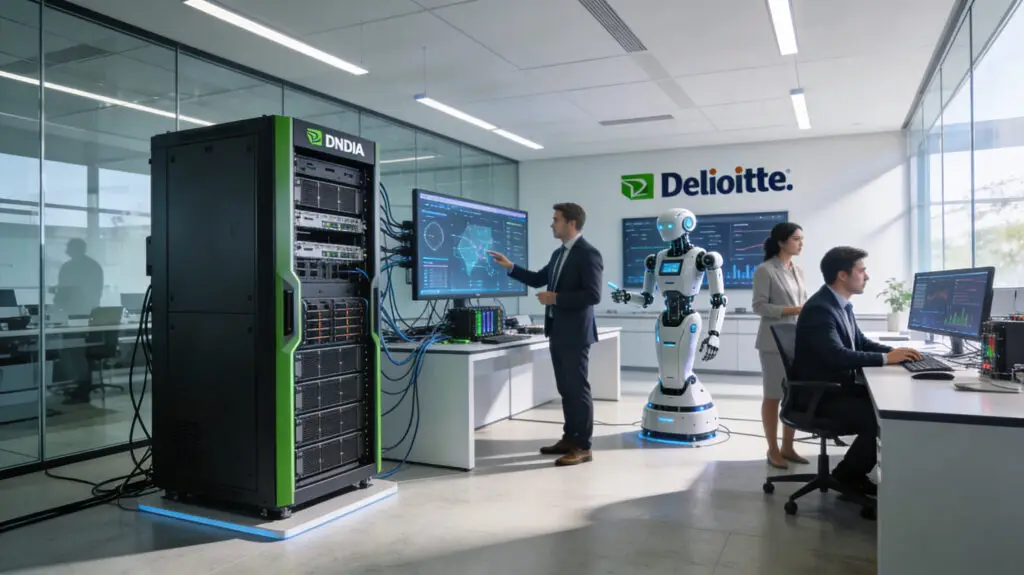
Deloitte and NVIDIA have teamed up to create a new physical AI solution that will help businesses around the world change how they do business. The partnership brings together Deloitte’s consulting skills and NVIDIA’s cutting-edge computing power to create intelligent automation systems that can grow with your business. The goal of this project is to use artificial intelligence in real-world settings where machines can work well with real-world conditions.
The solution lets businesses add smart systems that go beyond software by doing things in the real world. Companies can now use AI tools that look at their surroundings and make decisions based on data that is always coming in. This change is a big step forward in how businesses use AI in their day-to-day operations in a number of industries.
Source: ActulA
Physical AI Goes Beyond Normal Software Systems
Physical AI is a shift from traditional software-based models to systems that can interact with the real world directly. These systems use machine learning algorithms, sensors, robotics, and automation to do tasks on their own in changing environments. This lets machines do complicated tasks that used to need constant human supervision or manual intervention in many fields.
Physical AI is different from traditional AI because it lets machines act directly in the real world instead of just gathering digital information. This feature helps automate logistics, manufacturing, and customer service tasks where speed and accuracy are very important. Organizations become more efficient and less dependent on people to do dangerous or repetitive tasks.
Robotics And Automation Drive Operational Efficiency Gains
The solution adds AI-powered robots that can do repetitive and hard work more quickly and accurately. These smart machines can handle inventory, plan logistics, and deal with customers without needing people to be there all the time. Using robotics in business can greatly boost productivity and cut down on mistakes in important workflows.
As time goes on, physical AI can help businesses automate tasks, which can make things easier and lower costs. The ability to deploy scalable robotic systems makes sure that they work the same way in all environments and under all conditions. This makes the business more efficient in the long term and improves its overall performance and ability to compete in tough markets.
Recommended Article: Anthropic Plans Lawsuit After Pentagon Supply Chain Label
Real Time Data Enables Smarter Decision Making Systems
The platform uses high-performance computing and real-time data processing to make AI-driven systems more aware and responsive. Machines can constantly look at environmental data and change what they do based on how things are changing, without any delays or breaks. This makes sure that operations can still change and respond to real-world situations that are complicated and hard to predict.
AI systems can respond right away to changes in the environment thanks to real-time sensing capabilities. This makes decisions more accurate and operations more successful. This feature is especially useful in fields where exact timing has a direct impact on safety, productivity, and efficiency. These systems help organizations make smart choices in busy work environments.
Edge Computing Enhances Speed And System Responsiveness
The solution includes edge computing, which lets data processing happen closer to where it is created in real time. This cuts down on latency a lot and makes sure that systems respond faster than if they were only using centralized cloud infrastructure systems. Businesses benefit from better performance, especially in places where they need to act quickly and process data all the time.
Hybrid computing models mix edge and cloud capabilities to find the right balance between scalability, flexibility, and efficiency in all operations. This method lets systems work well even when there are problems with connectivity or when operations are going on. In distributed environments, organizations can count on reliable performance while still being highly responsive.
Industries Benefit From Real World AI Applications
Adopting physical AI technologies is likely to help a lot of industries, including manufacturing, healthcare, retail, and logistics. To keep productivity and operational efficiency high, machines and people in these fields need to work together in real time. Physical AI makes it easier for people and smart machines to work together on different operational tasks.
Companies can improve service quality, workplace safety, and operational outcomes by using AI in their physical workflows. This opens up new possibilities for innovation in places where people and machines have to work together well. Advanced AI technologies can help businesses change old ways of doing things into systems that are faster and more flexible.
NVIDIA Powers The Infrastructure Behind Real-World AI Systems
NVIDIA gives the basic hardware and software infrastructure that the solution needs to run advanced artificial intelligence workloads. Its GPUs and optimized platforms give it the high-performance computing power it needs for real-time processing and machine learning tasks. This makes sure that physical AI systems work well in a wide range of business applications and settings.
The partnership shows how technology companies and consulting firms work together to make artificial intelligence solutions that are ready for businesses all over the world. Companies can use scalable AI systems that are made for real-world use in a wide range of industries and situations. This partnership makes it easier for businesses all over the world to use cutting-edge AI technologies in their daily operations.