



CoinFello Adds MetaMask Support For OpenClaw
CoinFello said that its open source OpenClaw skill is now available for secure blockchain interactions with AI agents. The new feature works with MetaMask smart accounts to make transactions on the blockchain safe. This change makes AI-powered crypto agents even more useful.
The integration lets Moltbots’ personal AI agents work in OpenClaw environments and do things on the blockchain. These agents don’t have direct access to private keys; instead, they use delegated wallet permissions. So, the system puts security and user control first.
Source: The Block
Delegated Wallet Permissions Make Transactions Safer
The OpenClaw skill works with ERC 4337 smart accounts and ERC 7710 delegation frameworks. These technologies let AI agents make transactions without having to keep private keys safe. Security is still a key design principle for the platform.
Delegated permissions limit agents to certain actions that the user has already approved. This method makes sure that AI agents can’t get to more wallet features. So, the system makes security holes much less likely to happen.
The Principle Of Least Privilege Guides How Systems Are Built
CoinFello’s system design is based on the well-known cybersecurity rule of least privilege. AI agents only get the permissions they need to do a certain job. This method lowers the risks that come with using autonomous systems.
CoinFello turns natural language requests into blockchain transactions when users send them. Before a transaction can be carried out, an evaluation layer checks it. This extra step of validation makes the whole system more reliable.
Recommended Article: Oil Markets Swing Wildly Amid Trump Comments And War Risks
Natural Language Requests Start Execution On The Chain
Instead of complicated technical commands, users talk to the system in plain English. CoinFello automatically understands what users want and turns it into blockchain operations. This makes it much easier to interact with decentralized finance.
Once the system has finished processing, it creates delegated transactions that can be safely carried out onchain. AI agents do the tasks you ask them to do without ever directly accessing private keys. This architecture keeps strong protections for self-custody.
OpenClaw Ecosystem Shows Rapid Developer Growth
The launch happens at a time when the OpenClaw developer ecosystem is growing quickly. The GitHub repository for the project has already gotten more than 150,000 stars and 22,000 forks. So, developer engagement keeps growing quickly.
Recent data also shows that npm downloads have gone over 400,000 in just 1 month. This kind of growth shows that developers who make AI-powered blockchain tools are very interested. OpenClaw is becoming a more and more important framework.
AI Agent Wallet Security Goes Beyond Private Keys
Most of the time, traditional AI agent wallets store private keys or API credentials directly. This method makes sensitive data available in runtime environments and makes it easier for attackers to get to it. Security issues have limited its use by more people.
Some newer systems try to make security better by using trusted execution environments that run on servers. But these designs still depend on infrastructure providers that are centralized. The delegation model from CoinFello is a more decentralized option.
CoinFello Makes It Possible To Interact With Blockchains Automatically
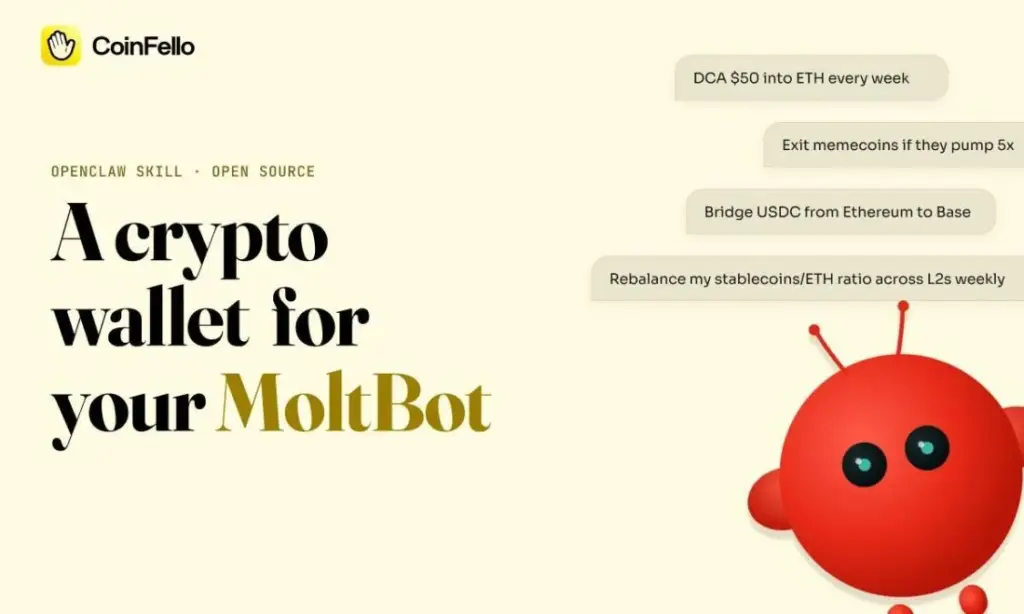
With the CoinFello skill, Moltbots can follow automated instructions to do a lot of different things on the blockchain. Supported tasks include lending, staking, bridging token swaps across networks, and rebalancing a portfolio. You can also use multi-step trading strategies.
The skill works with a number of token standards, such as ERC 20, ERC 721, and ERC 1155. Under the MIT license, developers can also change the open source code. This flexibility makes it more likely that more people will use it in Web3 ecosystems.