


XRP Drops as Cryptocurrency Markets React to Global Risk Sentiment
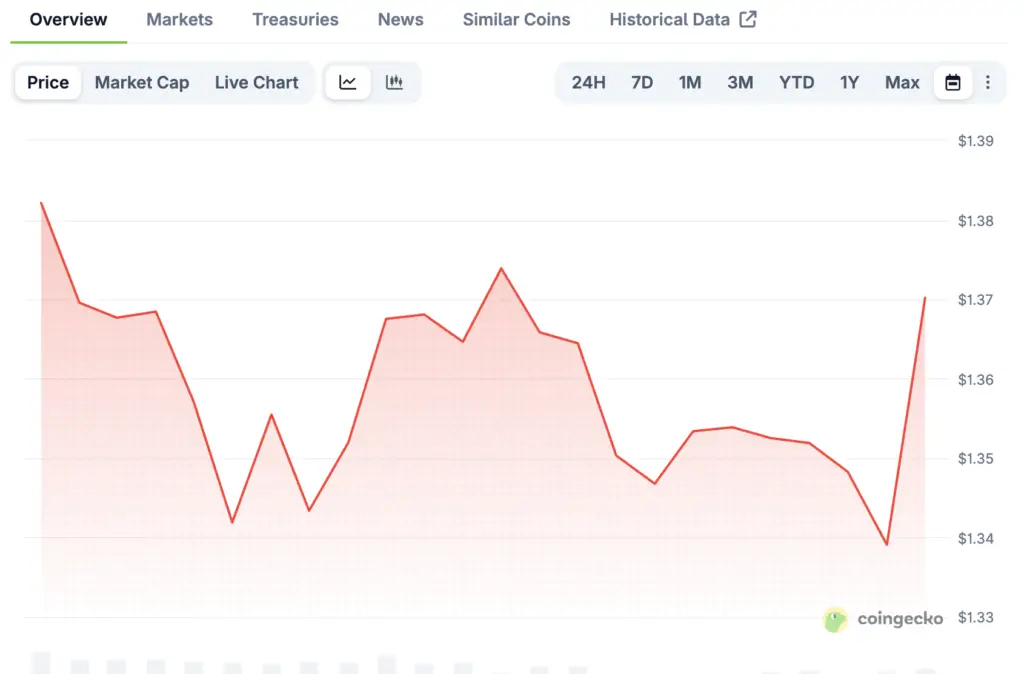
XRP fell for the 2nd day in a row as the rest of the cryptocurrency markets reacted to rising global geopolitical tensions. The token traded close to $1.35, but investors were still cautious because of the growing conflict between the US and Iran. Many traders are moving their money into safer assets and away from volatile cryptocurrencies because of the increased uncertainty in the financial markets.
The recent sell-off started after military events made investors around the world less willing to take risks over the weekend. XRP fell to $1.27 for a short time before bouncing back and rising to $1.43. Even though this bounce back, experts think that the overall state of the market is still not good for long-term growth in cryptocurrency prices.
Escalating Middle East Conflict Adds Pressure to Risk Assets
More and more tensions in the Middle East have made the markets even more uncertain, which has changed how investors act in many financial sectors. Reports say that Iran has stepped up its military actions in the region, affecting several countries and raising geopolitical concerns around the world. When conflicts threaten economic stability or make it hard for international trade to happen, investors often cut back on their exposure to risky assets.
The energy markets have also reacted strongly, with oil prices going up because people are worried about supply problems. Higher energy costs could make things even harder for economies around the world that are already having trouble with inflation. Traders often cut back on their positions when there is geopolitical instability because cryptocurrencies act like high-risk assets.
Weak Retail Demand Signals Reduced Investor Confidence
Recent data on derivatives trading shows that fewer retail investors are participating in XRP markets. According to CoinGlass, the open interest in futures has dropped from $2.26 billion the day before to about $2.16 billion. This drop brings the open interest level down to its lowest point since January 2025.
When open interest goes down, it usually means that traders are closing positions instead of opening new ones. This behavior shows that retail investors are less sure about how prices will behave in the near future. Analysts say that when fewer people participate, it often means that prices will stay the same for a long time or go down even more.
Recommended Article: AI Predicts XRP Drop As U.S.–Iran Conflict Raises Market Risks
Historical XRP Trading Activity Highlights Changing Market Interest
In the past, investors were much more active when the cryptocurrency market was going up. In July, when XRP was on its way to its all-time high, futures open interest hit a record $10.94 billion. During that time, the token hit about $3.66 because there was a lot of demand for it in cryptocurrency markets around the world.
The difference between the previous peak in participation and the current levels shows that speculative interest is waning. As macroeconomic and geopolitical risks affect financial markets, traders seem to be getting more careful. These kinds of changes can have an effect on the liquidity of cryptocurrencies and short-term trading.
Institutional Interest Remains Modest Despite ETF Inflows
Even though some exchange-traded funds saw small inflows, institutional activity around XRP is still pretty quiet. According to reports from the market, spot XRP ETFs brought in about $2.21 million on Friday. Total weekly inflows were about $9.55 million, bringing the total assets under management to about $983 million.
Even though these inflows show some institutional interest, they are still small compared to the flows into major cryptocurrencies. Institutional investors usually put more value on assets that have a larger market capitalization and better liquidity profiles. This preference right now is for Bitcoin and Ethereum over smaller cryptocurrency projects.
Bitcoin and Ethereum Attract Larger Institutional Investment
CoinShares says that last week, digital asset investment products brought in about $1 billion. The new inflows ended a 5-week period of steady outflows of about $4 billion across all cryptocurrency markets. Only $1.9 million of the total inflows during that time came from XRP-related products.
Bitcoin got the most money, with about $886 million going into investment products that track the cryptocurrency. Ethereum came next, with about $117 million coming in, showing that institutions are interested again. These numbers show that institutional investors are still putting most of their money into the biggest digital asset markets.
Technical Indicators Suggest Bearish Trend May Continue
Technical analysis shows that XRP is still in a larger bearish trend, even though it has tried to recover in the short term. The token is trading below the 50-day, 100-day, and 200-day exponential moving averages, which are all between $1.58 and $2.05. These indicators that are going down suggest that there is a lot of selling pressure in the larger cryptocurrency market.
Momentum indicators also give mixed signals about whether prices will rise in the near future. The relative strength index is still below the neutral 50 level, which means that sellers are still in charge. Analysts say that a clear move above the $1.40 resistance level could make people feel better, while a failure could test support near $1.27.