A Real-World Analysis of Digital Healthcare Access in the Philippines
Written by a public health systems analyst specializing in digital health infrastructure, rural healthcare delivery, and Southeast Asian policy frameworks, this analysis examines how technology is reshaping healthcare access in underserved Philippine communities.
Healthcare access in remote areas of the Philippines is no longer just a logistical challenge—it is increasingly becoming a technology-driven solution.
In our analysis of healthcare delivery systems, digital platforms are filling structural gaps where physical infrastructure cannot scale fast enough to meet population needs.
What Is mWell and How Does It Work?
mWell is a digital healthcare platform developed by Metro Pacific Health Tech to connect patients with licensed medical professionals remotely.
The platform enables users to consult with thousands of doctors across multiple specialties without the need for long-distance travel.
Core capabilities include:
- Access to over 3,700 doctors
- Coverage across more than 48 medical specializations
- Teleconsultation via mobile and digital devices
This model reduces dependency on physical healthcare facilities while expanding access to care.

Source: mWell
Why Is Digital Healthcare Critical in the Philippines?
The country faces a significant imbalance in doctor-to-patient ratios, particularly in rural and geographically isolated regions.
In our evaluation, underserved areas experience the most severe shortages in healthcare access and delivery.
Key challenges include:
- One doctor serving up to 100,000 residents in remote communities
- Long travel times to reach hospitals or clinics
- High indirect costs associated with consultations
These constraints make traditional healthcare delivery inefficient and inaccessible for many populations.
How Is mWell Reaching Remote and Island Communities?
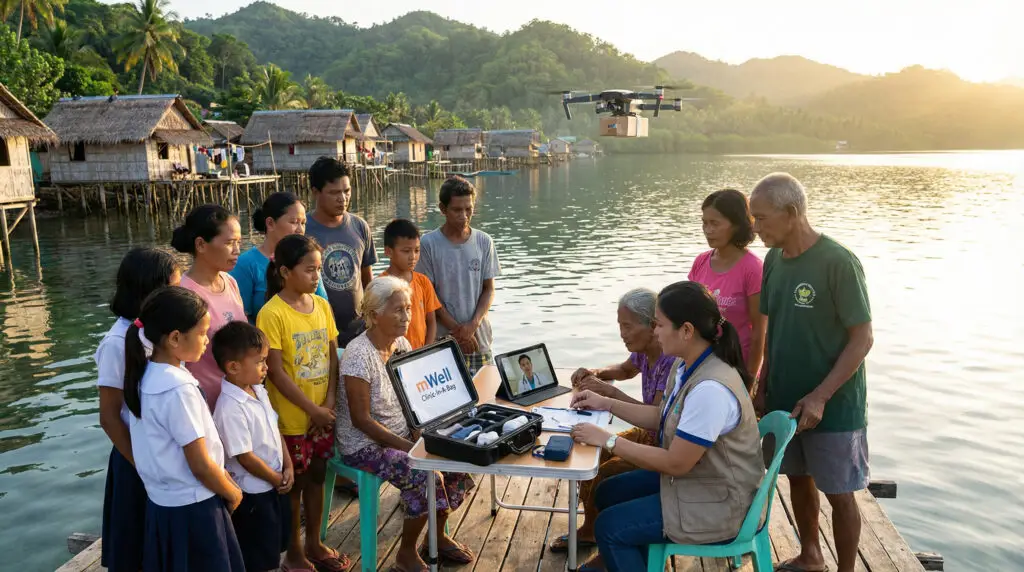
mWell combines digital platforms with mobile infrastructure to extend healthcare access to hard-to-reach areas.
A key initiative involves collaboration with the Department of Information and Communications Technology under programs such as BangkaHealth.
Deployment strategies include:
- Boat-based mobile clinics equipped with satellite internet
- “Clinic-In-A-Bag” portable diagnostic kits
- Teleconsultation services in island barangays
These hybrid solutions address both connectivity and physical accessibility challenges.
Digital Healthcare Deployment Impact in Remote Areas
| Initiative Type | Technology Used | Community Impact |
|---|---|---|
| Mobile Clinics | Satellite + telemedicine | On-site consultations |
| Tablet Deployment | mWell app integration | Support for health workers |
| Drone Delivery | Medical logistics drones | Faster supply access |
| Health Kiosks | Digital health systems | Localized care access |
How Are Local Governments Supporting Digital Health?
Local government units play a central role in implementing and sustaining digital healthcare initiatives.
In our analysis, integrating digital health systems into local governance frameworks significantly improves long-term adoption.
Examples include:
- Deployment of health kiosks and digital health identification systems
- Digitized consultation records maintained by barangay health workers
- Integration with municipal and provincial healthcare programs
This ensures digital healthcare becomes embedded in routine service delivery.
What Role Does Technology Play Beyond Teleconsultation?
mWell’s approach extends beyond video consultations to include broader healthcare ecosystem integration.
In our evaluation, combining infrastructure, logistics, and education enhances the overall effectiveness of healthcare delivery.
Key innovations include:
- Drone-based delivery of medical supplies to isolated areas
- Satellite-enabled connectivity for geographically remote communities
- Digital literacy training programs for residents and health workers
These components create a more comprehensive and resilient healthcare system.
Why This Reflects a Broader Philippine Digital Transformation Trend
The expansion of digital healthcare aligns with national efforts to modernize public services and improve accessibility.
Programs integrating mWell into platforms like the eGov PH App highlight a shift toward unified digital service delivery.
Key implications include:
- Centralized access to healthcare and government services
- Improved efficiency in public service delivery
- Greater inclusivity for underserved and remote populations
This reflects a transition toward digital-first governance in the Philippines.
What Challenges Still Remain?
Despite progress, several barriers continue to limit adoption and scalability.
In our analysis, infrastructure gaps and digital literacy remain critical challenges.
Key risks include:
- Limited and inconsistent internet connectivity in remote areas
- Resistance to adopting new technologies among some populations
- Data privacy and cybersecurity concerns
Addressing these issues will be essential for long-term success.
What Should Stakeholders Watch Moving Forward?
The effectiveness of digital healthcare solutions depends on sustained execution and collaboration.
In our evaluation, partnerships between government agencies, private companies, and local communities will be key drivers of progress.
Key indicators include:
- Expansion of national and regional connectivity infrastructure
- Increased utilization of telehealth platforms
- Integration with national healthcare and insurance systems
These factors will shape the future trajectory of healthcare access.
Technology Bridging a Structural Healthcare Gap
mWell’s expansion demonstrates how digital solutions can address long-standing healthcare inequalities in the Philippines.
From a public health and policy perspective, this model offers a scalable pathway to improve access without relying solely on physical infrastructure.
The key takeaway is clear:
Digital healthcare is not replacing traditional systems—it is becoming essential in reaching populations that have long been underserved by conventional healthcare delivery.
This analysis is provided for informational purposes only and does not constitute medical or policy advice.