



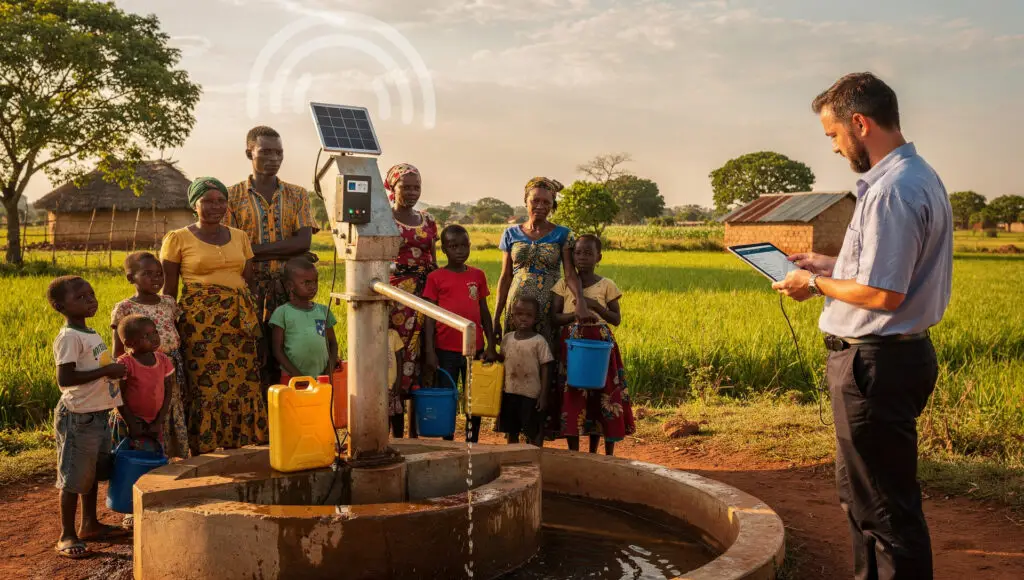
Irish Innovation Tackles Global Water Challenges
A smart sensor that was made in Donegal, Ireland, is helping to keep clean water supplies safe in rural Uganda. Engineers at the Atlantic Technological University (ATU) in Letterkenny came up with the idea for the new technology, which keeps an eye on how well handpumps work in boreholes and lets them know when something goes wrong before communities lose access to safe water. Researchers say the project could soon spread to other developing countries that are having similar problems.
The solar-powered technology has been in development at ATU’s Wireless Sensor and Applied Research (WiSER) lab since 2019. Its goal is simple but life-changing: to keep important rural water systems running by finding mechanical problems early. For a lot of communities in Uganda, this can mean the difference between having clean drinking water and being exposed to contamination that could kill them.

Source: OpenAIRE
Fighting Contamination Through Smart Monitoring
Thousands of people in Uganda’s rural areas depend on handpumps to get water from boreholes. When pumps break down, people in the village often have to use surface wells that are not safe and are full of bacteria like E. coli. Local governments are in charge of keeping an eye on hundreds of sites, but they often don’t have the right tools to do so.
The smart sensor designed in Donegal is the answer. It keeps track of the amount of water, the number of pump handle strokes, and the pump’s side-to-side movement. It sends hourly updates to a cloud-based platform in Ireland through Uganda’s mobile network. This remote system makes sure that problems are found early so that local technicians can fix them before they cause problems with the supply.
Collaboration Between Ireland and Uganda
In September, the most recent phase of the project took place. Research engineer Sennan Morris went to Uganda’s eastern Kumi region. There, he put ten of the newest sensor prototypes into working boreholes. A small solar panel powers each device, so they work well in places without power.
Morris said, “They’re always watching,” but “it only ‘wakes up’ once an hour and ‘phones home.'” The research team looks over the data sent to ATU’s servers in Donegal. If they find anything strange, they can tell Ugandan mechanics right away.
Recommended Article: Comelec to Showcase New Automated Election Technology
Seamless Technology for Sustainable Impact
Even though communication between continents may seem hard, it works very well. If a problem is found, ATU researchers send a text message to a nearby technician right away. The technician can then go to the site to fix the problem. This alert system that works in real time cuts down on downtime by a lot, making sure that people can always get clean water.
Morris says that managing repairs from thousands of kilometers away “sounds a bit funny,” but the team plans to give their partner charity, Fields of Life, full operational control in the next year. This will give local groups the power to run the network on their own.
Taking the Project to Other Countries
People are already interested in the Donegal technology outside of Uganda. ATU has been asked by NGOs and aid groups to put in similar systems in Liberia and other African countries where borehole pumps are the main way for people to get water. The research team thinks that the design can be easily changed to fit different infrastructure and local conditions.
The ATU project shows how localized innovation can lead to global solutions for water security by using solar power, wireless connectivity, and cheap sensors.
Pride and Purpose in the Project
The engineers who worked on the technology say that the project’s effects go far beyond just helping students do better in school. Morris said, “It makes me very proud to see something made in humble Letterkenny have a lasting effect on the good people of Uganda.” His feelings are in line with the main goal of ATU’s WiSER lab, which is to use cutting-edge sensor research to solve real-world problems.
The project started after Ray Speer, a board member of the research center, went to Uganda and saw for himself how bad the effects of pump failures were. His experience motivated the team to use their skills to create a monitoring solution that works across continents and is environmentally friendly.
Building a Blueprint for Global Clean Water Access
As the project comes to an end, its success in Uganda could lead to its widespread use in sub-Saharan Africa and beyond. The system helps reduce waterborne illness, makes communities more resilient, and supports long-term public health by letting local response teams keep boreholes clean.
The partnership between Donegal and Uganda shows how new ideas from small academic labs can have a big impact on the world. ATU’s smart water monitoring network could soon be a model for protecting one of the most important resources for people: clean, safe water. This will happen if they keep working together and getting money.