Artificial Intelligence Becomes the Industry’s Fastest-Adopted Tool
Artificial intelligence is the technology that has been embraced the quickest in history, even faster than messaging apps like WhatsApp. AI is increasingly used in hospitality for marketing, operations, and guest interaction, but there is still a lot of dispute about what this means for the future.
Experts in the field say that AI is not a comprehensive solution but rather a facilitator that lays the groundwork for process improvement and innovation. Hotels employ AI to improve pricing models, guess what customers want, and help departments make better decisions.

From Gimmicks to Genuine Progress in Hospitality
The hotel industry is trying out a lot of different AI applications, such as AI-assisted chefs making recipes and dynamic guest-experience platforms. But a lot of specialists say that these technologies shouldn’t be seen as gimmicks without results that can be measured.
They say that real innovation comes from combining technology with understanding. AI can make work easier, but to make guests’ experiences really memorable, you still need human intuition and empathy. Data alone can’t do it.
Recombination: The Core of Modern Innovation
Joseph Schumpeter, an economist who died in 1950, said that innovation is the “recombination of existing resources.” This notion is directly relevant to AI’s potential in the hotel industry. AI may create new value by merging current technologies, just like smartphones did by mixing cameras with communication capabilities.
AI has already made big strides in fields like drugs by combining molecules in new ways. But in the hotel industry, where emotional intelligence and tacit knowledge are very important, the problem is turning data aggregation into innovation that focuses on people.
Recommended Article: Fortnite Returns to Google Play After Major Legal Victory
The Increasing Importance of Using AI Responsibly
There are worries about the quality of fully AI-generated commercial documents and academic papers since they often feature made-up references and factual mistakes. Similar problems have happened in businesses, such as well-known incidents of AI-assisted reporting that was wrong.
This shows how important it is for managers and employees to know how to use AI and be responsible for it. Companies need to set rules so that technology helps people do their jobs better instead of taking over and so that every process stays accurate, honest, and trustworthy.
Sustainability and Customization Lead Innovation Streams
Sustainability, customization, labor solutions, and new business models are some of the most important things that drive innovation in the hotel industry, along with AI. Sustainability today covers the whole life of a hotel, from using eco-friendly building materials to getting electricity from renewable sources and food from nearby farms.
More and more, guests prefer businesses that have less of an impact on the environment and help local communities. Hotels respond by adding energy-saving technologies, cutting down on waste, and utilizing data to help tourists find less congested places to stay and things to do during the off-season.
Overcoming Labor Shortages With Smart Technology
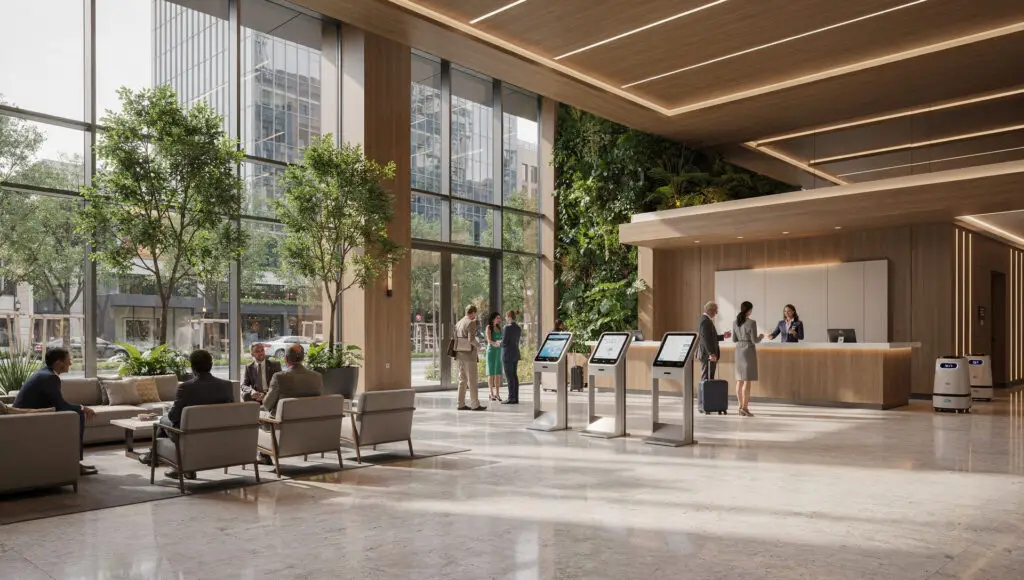
After the epidemic, the worldwide hotel business is still having trouble finding enough workers. Some of these gaps are being filled by automation and robots, which allow for contactless check-in, digital concierge services, and robotic food delivery.
But a lot of operators still have trouble finding the right mix between being efficient and being friendly. Too much automation may hurt the personal connection that makes hospitality special, while too little automation might make a business less competitive. To be successful, you need to make sure that technology meets the needs of your guests.
Innovation Barriers and the Risk of Organizational Inertia
Corporate inertia is still the biggest barrier to innovation, especially in big hotel chains that don’t want to adapt. Kodak is a good illustration of how established skills may become rigidities. They invented digital photography but didn’t change with the times.
Many hospitality firms are now working with startups or buying up-and-coming brands to get out of a rut. But buying companies may also inhibit creativity if it makes people less independent. The Disney-Pixar model illustrates that keeping creative freedom within a business may lead to long-term innovation.
Keeping the Human Element at the Heart of New Ideas
Automation and digitization are still making progress, but hospitality is still an industry that is mostly run by people. Real innovation must take into consideration emotions, memories, and psychological responses, things that no algorithm can measure yet.
Researchers are looking for ways to quantify emotional involvement that cross several fields, such as how smells, sounds, and the ambiance affect how happy guests are. The next big thing in hospitality will probably happen when human empathy and technical accuracy come together.
A Future Built on Collaboration and Responsible Progress
As technology changes, the hotel sector has to understand how to work with AI in a responsible way, leveraging it to improve innovation, sustainability, and operational excellence. More and more, hotels will combine technology with art and efficiency with passion.
Ultimately, the next wave of advancement will depend on leaders who value both digital intelligence and human connection. They will make sure that new ideas improve, not replace, the core of hospitality.