



Bangladesh Unveils Its First National AI Readiness Assessment
Bangladesh has issued its first Artificial Intelligence Readiness Assessment Report to support ethical and inclusive AI development. The study aims to guarantee that artificial intelligence promotes public institutions while respecting citizens’ rights and promoting innovation. The inaugural event took place at the Bangladesh Computer Council Auditorium in Dhaka.
Organized by the ICT Division, a2i, UNESCO, and UNDP Bangladesh, the event included senior government officials, development partners, and civil society leaders. Together, they highlighted that AI must empower humans and preserve social and ethical values.
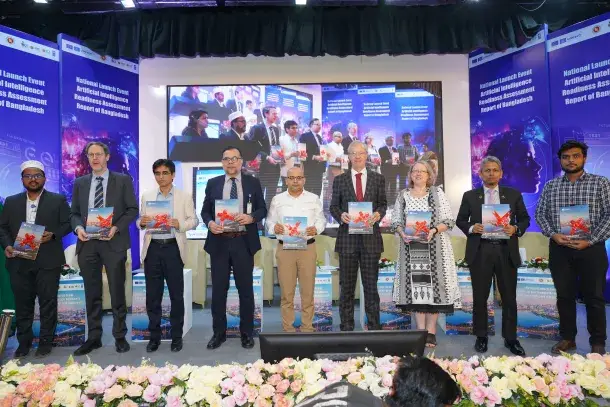
Report Highlights Strengths In Digital Governance And Trust
The report indicated that Bangladesh has developed a strong foundation in e-government and enjoys high levels of digital trust. Decades of investment in digital transformation have positioned the country well for embracing innovative technology responsibly.
However, the research also found gaps in infrastructure and skills that must be addressed to guarantee fair AI deployment. Uneven internet access and scarce high-end computers remain key difficulties for rural and poor locations.
Bridging The Digital Divide For Inclusive AI Development
Persistent gender and urban-rural disparities were recognized as impediments to inclusive AI governance. The paper suggests extending digital literacy initiatives and boosting access to technology for women and marginalized populations. Such actions would guarantee that AI advantages reach every person equitably.
The findings underline that inclusion is necessary, not optional, for constructing trustworthy AI systems. If these existing divisions aren’t addressed, Bangladesh might see growing inequality as automation becomes more common.
Recommended Article: Pope Urges Caution In Using Artificial Intelligence In Medicine
Policymakers Emphasize Evidence-Based Decision Making
At the inauguration event, ICT Division Secretary Shish Haider Chowdhury emphasized the need for basing policy decisions on evidence, rather than on speculation. The AI Readiness Report contains important information that can help create clear governance frameworks.
These findings will influence the development of Bangladesh’s National AI Policy, ensuring that public AI systems are explainable, responsible, and consistent with the country’s ideals. Collaboration across universities will be reinforced, fostering uniform and open AI techniques.
UNESCO Commends Bangladesh For Ethical AI Commitment
Dr. Susan Vize, UNESCO’s Head of Office in Bangladesh, characterized the evaluation as a dual-purpose tool: a “mirror and a roadmap.” It offers a snapshot of the country’s current standing and, simultaneously, a guide for enhancing AI governance and infrastructure.
She commended Bangladesh for its adherence to UNESCO’s worldwide Recommendation on the Ethics of Artificial Intelligence, a document embraced by all 193 member states. This framework aims to guide the nation in harmonizing innovation with fundamental human rights, environmental sustainability, and the embrace of many cultures.
UNDP Highlights The Importance Of Human-Centered Innovation
Stefan Liller, the UNDP’s Resident Representative, noted that Bangladesh’s embrace of ethical AI principles offers a commendable model for the world. He stressed the need of keeping technology grounded in justice, equity, and responsibility.
He observed that the impact of AI on inequality hinges on the decisions we make now. The effectiveness of artificial intelligence in supporting human growth will depend on investments in connection, the quality of data, and the ability for governance.
Turning Recommendations Into Action For Public Services
Md. Abdur Rofiq, from a2i, stressed the need to put the report’s recommendations into practice, focusing on improving governance. He emphasized the need to leverage AI to improve critical services such as healthcare, education, and social safety nets.
EU policymakers reiterated their backing for the development of reliable AI ecosystems. They were hopeful that the plan will enable young people, women, and others in vulnerable situations to benefit from innovation that is equitable for all.