



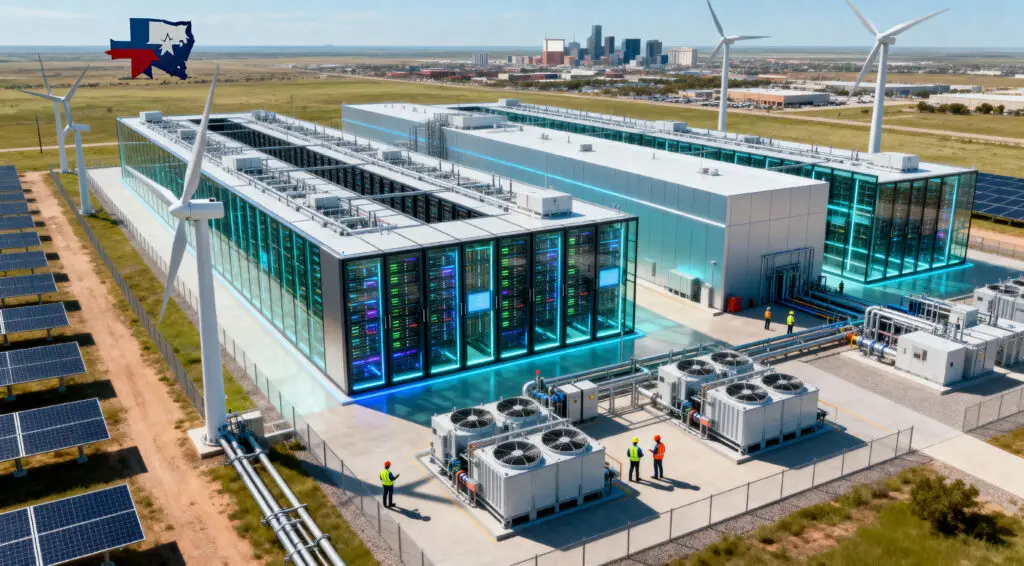
Big Tech Hook AI Infrastructure Race Accelerates
Written by a technology infrastructure analyst specializing in cloud computing, data centers, and AI systems, this analysis evaluates how large-scale capital deployment is reshaping the global tech landscape.
In our analysis of the sector, Google’s $40 billion investment signals an intensifying race among major firms to build AI infrastructure at unprecedented scale.
The move reinforces Texas as a central hub for data centers, cloud services, and next-generation artificial intelligence systems.

Details of Google’s Texas Investment
The scale of the investment reflects long-term strategic positioning in AI and cloud computing.
Key details include:
- Approximately $40 billion allocated through 2027
- Development of new data center campuses in northern Texas
- Expansion of a long-standing operational presence in the state
This initiative is designed to strengthen computing capacity while supporting workforce development and regional growth.
Why Texas Is Attracting Big Tech
Texas continues to draw large-scale technology investments due to structural advantages.
Key factors include:
- A deregulated energy market enabling flexible power sourcing
- Access to renewable energy at competitive costs
- A business-friendly regulatory and tax environment
In our evaluation, these elements make Texas particularly attractive for energy-intensive AI workloads.
Rising Energy Concerns Around Data Centers
The rapid expansion of data centers introduces infrastructure challenges.
Key issues include:
- Increased strain on local power grids
- Historical vulnerabilities highlighted by events such as the 2021 winter outages
- Surging electricity demand driven by AI training and cloud computing
Balancing infrastructure growth with energy stability remains a critical constraint.
Google’s Energy Commitment
To address these concerns, Google has outlined targeted energy initiatives.
Key actions include:
- Launch of a dedicated energy impact fund
- Investment in local grid resilience and infrastructure
- Commitments to offset operational energy usage through sustainable sourcing
This reflects a broader industry shift toward integrating sustainability with infrastructure expansion.
Broader Trend Tech Giants Expanding in Texas
Google’s move is part of a wider concentration of technology investment in the region.
Notable developments include:
- AI infrastructure expansion tied to OpenAI initiatives
- Data center investments from Meta
- Headquarters relocation by Tesla to Austin
- Strategic moves by Oracle into the state
- Semiconductor manufacturing projects led by Samsung Electronics
In our analysis, this clustering effect is accelerating Texas’s role as a global technology hub.
Capital Spending Reflects AI Ambitions
The investment aligns with broader capital expenditure trends across Big Tech.
Key figures include:
- Tens of billions in annual capital spending focused on AI infrastructure
- Majority allocation toward data centers, chips, and cloud systems
This underscores the scale and urgency of competition in AI development.
Strategic Importance of AI Infrastructure
Control over infrastructure is becoming a defining competitive advantage.
Key implications include:
- Faster AI model training and deployment cycles
- Greater control over cloud ecosystems and data pipelines
- Strengthened positioning in global technology leadership
In our evaluation, infrastructure capacity is now as critical as software innovation.
Outlook Texas as the AI Backbone of the US
Texas is rapidly positioning itself as a cornerstone of the AI economy.
With sustained investment from multiple industry leaders, the state could become one of the most important global centers for large-scale computing and artificial intelligence deployment.
Infrastructure Defines the AI Era
Google’s $40 billion commitment reflects a broader structural shift in the technology sector.
From a strategic perspective, AI leadership will be determined not only by algorithms, but by the ability to build and sustain massive computing infrastructure.
The key takeaway is clear:
Regions capable of supporting large-scale energy, data, and compute demands will shape the future of the global AI landscape.
This analysis is provided for informational purposes only and does not constitute financial or investment advice.