Juan Ponce Enrile Dies at 101 After Seven Decades in Public Service
MANILA — Juan Ponce Enrile, a politician whose political career in the Philippines was both long-lasting and often contentious, has passed away at the age of 101. Katrina Ponce Enrile, his daughter, said that he died at 4:21 p.m. on Thursday. This marked the end of a political career that stretched from the time of Marcos Sr. to that of Marcos Jr.
Enrile was acting as Chief Presidential Legal Counsel under President Ferdinand Marcos Jr. when he passed away. He held the distinction of being the oldest active public official in the nation, a veteran of Philippine politics whose career spanned decades, encompassing both notable accomplishments and periods of contention.
Early Life and Legal Foundations
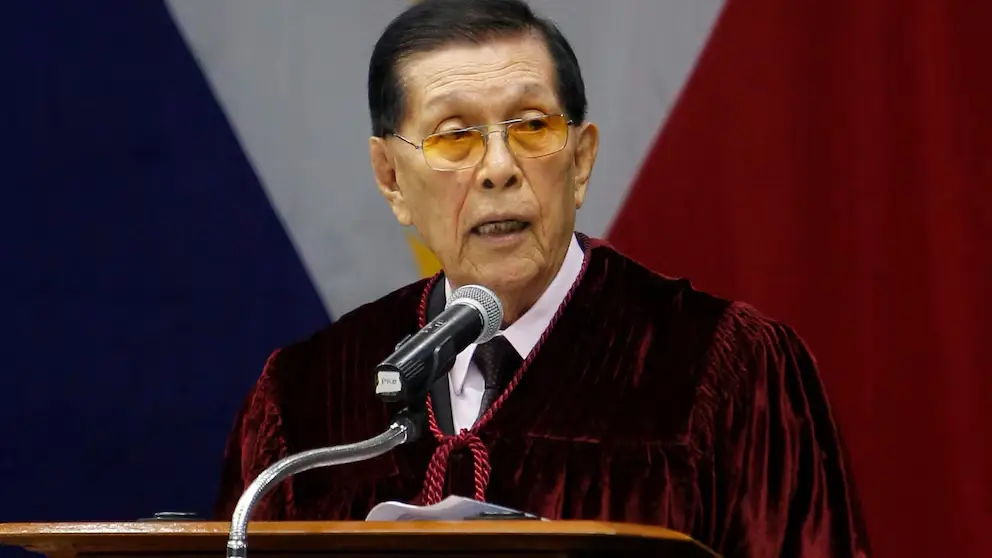
Born on Valentine’s Day in 1924, in Cagayan, Enrile’s journey from modest origins to a position of national significance showcased his sharp mind and political savvy. He received his Bachelor of Laws from the University of the Philippines, finishing cum laude in 1953. Two years later, in 1955, he got a Master of Laws from Harvard Law School.
His legal training became the bedrock of a public life that was both celebrated and contentious. Renowned for his legal acumen and often scrutinized for his political tactics, Enrile was a constant presence in Philippine politics for over seventy years.
From Marcos Protégé to Martial Law Architect
Enrile’s political career began under Ferdinand Marcos Sr. in 1965, starting with his role as Commissioner of the Bureau of Customs, followed by positions as Undersecretary and Acting Secretary of Finance, and ultimately as Justice Secretary.
His most significant and controversial role was as defense minister from February 9, 1970, where he was viewed as a principal architect of the martial law imposed by Marcos in 1972, initiating a two-decade authoritarian regime. Enrile’s involvement in enforcing martial law established him as a powerful yet divisive figure during this period.
Recommended Article: South Korea Indicts Ex-President Yoon for Aiding the Enemy
A Dramatic Turn During the 1986 People Power Revolution
In a dramatic turn of events, Enrile pulled his backing from Marcos Sr. in February of 1986. He subsequently aligned himself with Fidel V. Ramos, who was then the Deputy Chief of the Armed Forces. Their departure ignited the EDSA People Power Revolution, a nonviolent movement that toppled Marcos after twenty years and brought democracy back to the Philippines.
Enrile’s role in the uprising shifted his image dramatically. He went from being a figurehead of martial law to a key player in the revolution. His choice to part ways with Marcos Sr. stands as a defining moment in the Philippines’ political landscape.
From Revolutionary to Senate Leadership
Following the revolution, Enrile transitioned into a legislative role. He won a Senate seat, and throughout the years, he would be re-elected, ultimately becoming the Philippines’ 21st Senate President.
As Senate leader, Enrile built a reputation as a savvy political strategist and a constitutional authority. He frequently maneuvered through heated legislative battles, displaying his characteristic acuity. Even with the constant battles against political foes, he had a dominant position in the Senate for many years.
Controversy and Enduring Influence
Enrile’s career was characterized by both controversy and recognition, particularly for his actions during martial law and his adaptability across various political regimes. Supporters viewed him as a figure of stability, while critics regarded him as a symbol of the moral dilemmas within Philippine politics.
In his later years, he returned to politics as Chief Legal Counsel for President Marcos Jr., re-engaging with a family he once helped displace from power.
A Legacy of Paradox and Power
Juan Ponce Enrile’s passing signals the close of a significant chapter in the political history of the Philippines. His life, which lasted a century, highlighted the nation’s complex political history, including the period after the war, the rise of dictatorship, the revolution, and the eventual move towards democracy.
Admired for his intellect and determination but also marked by his involvement in a particularly grim period of Philippine history, Enrile’s legacy is undeniably multifaceted. His life, which included being an ally of Marcos, then a rebel, a senator, and a statesman, demonstrates the endurance and inconsistencies inside Philippine democracy.
As condolences and remembrances flood in from all corners of the political landscape, Enrile’s legacy will be that of a resilient and influential player, one who navigated and endured practically every significant political shift in the Philippines’ recent history.