


Discovery Of The Most Distant Galaxy Ever Observed
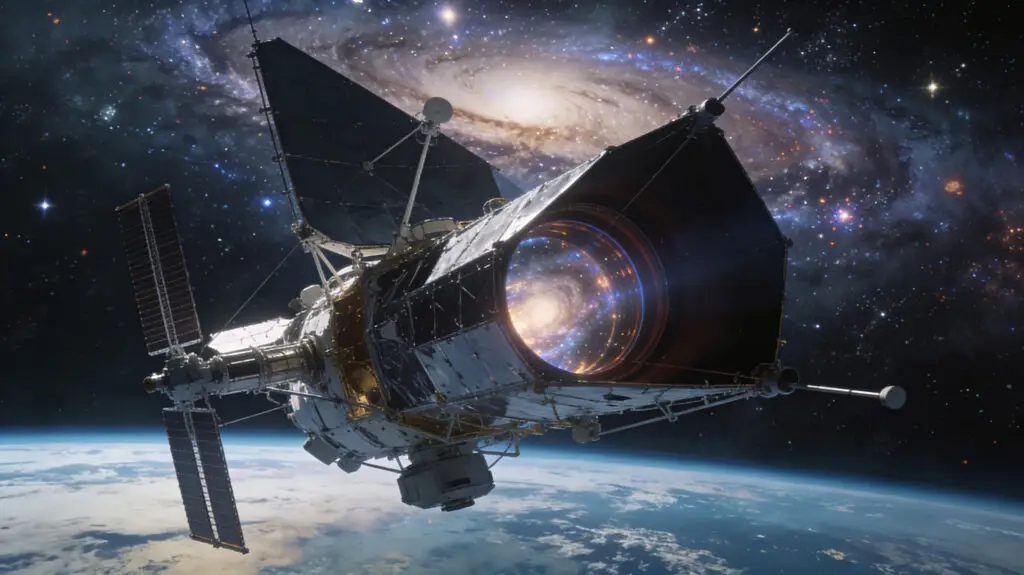
The James Webb Space Telescope found MoM-z14 to be the farthest galaxy ever seen. The galaxy was there only 280 million years after the Big Bang, during the cosmic dawn. It took its light about 13.5 billion years to reach instruments on Earth and in space.
This finding takes observational limits deeper into the universe than any other telescope has been able to do. Astronomers can look at very faint and faraway cosmic objects with Webb’s advanced infrared capabilities. MoM-z14 gives us a never-before-seen look at how the universe’s first structures formed.
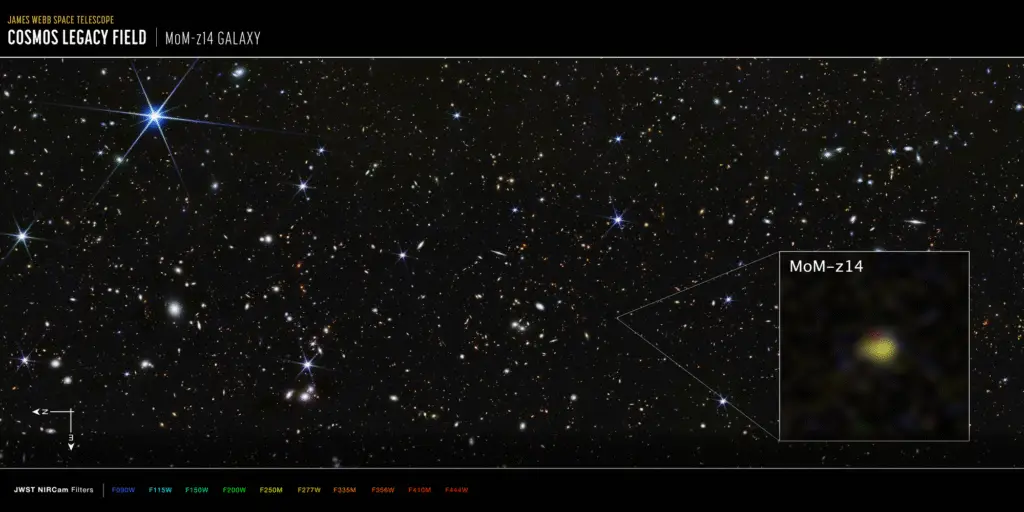
Source: NASA Science/Website
Why MoM-z14 Poses Challenges to Current Galaxy Formation Models
MoM-z14 looks brighter and more chemically mature than what theoretical models said it would look like at this early time. Scientists thought that early galaxies would be dim, spread out, and mostly made of hydrogen gas from the beginning of time. This galaxy, on the other hand, has a dense structure and a surprising amount of elemental complexity.
These surprising traits point to the possibility that stars formed faster and better than scientists thought before. Older models thought that stars built up slowly over long periods of time in the universe. MoM-z14 suggests that early galaxies might have changed quickly in ways we don’t yet understand.
Chemical Signatures Show How Quickly Stars Change
Observations showed that MoM-z14’s compact galactic structure had nitrogen levels that were higher than normal. This kind of chemical enrichment means that huge stars were born and changed very quickly when the universe was still young. These stars probably didn’t live very long and added more material to the area around them sooner than expected.
Researchers looking at Webb’s data were also surprised that there was no primordial hydrogen gas nearby. This implies that vigorous star formation rapidly depleted the available gas within the galaxy. These results call into question what we thought we knew about gas availability in the early universe.
Recommended Article: SpaceX And xAI Merger Talks Fuel Musk 2026 IPO Strategy
How James Webb Helped Make This Amazing Discovery
James Webb’s infrared tools can pick up redshifted light from the oldest galaxies in the universe. Older telescopes weren’t sensitive enough to see things that were so far away and dim. Webb’s design is meant to help us explore the early universe by giving us unprecedented resolution and depth.
In April 2025, the telescope saw MoM-z14, and the results were later published in a peer-reviewed astrophysics journal. Because of its accuracy, it was possible to do detailed chemical and structural analysis that was not possible before. Webb keeps pushing the limits of what people can see in cosmic history.
Growing Gap Between Theory And Observation
Researchers working on the study saw that the gap between what they thought would happen and what they actually saw was getting bigger. Current models have a hard time explaining how galaxies like MoM-z14 formed so quickly and well. This difference shows that current cosmological simulations have some problems.
Scientists see this difference as a chance to improve astrophysics, not a problem. New information makes it necessary to improve theories and computer models of the early universe. Webb’s discoveries are prompting a reevaluation of enduring beliefs regarding cosmic evolution.
What This Means For Understanding The Early Universe
The discovery indicates that the formation of early galaxies may have been more dynamic and energetic than previously thought. In the beginning, the universe may have changed faster because stars formed quickly. This has consequences for comprehending reionization and primordial cosmic chemistry.
MoM-z14 could be a part of a larger group of early bright galaxies that have not yet been found. If these kinds of galaxies were common, we would have to change the timelines for the early development of the universe. Webb’s ongoing mission may find many other objects like this that change the course of cosmological history.
What Webb’s Future Discoveries Might Show
Astronomers think that James Webb will keep finding galaxies that are breaking records from the universe’s early days. Every new discovery gives us important information that helps us improve our ideas about how the universe began and how structures formed. Webb’s mission is still in its early stages of operation.
Future observations may show how common rapid early galaxy evolution really was. Scientists expect to find more surprises that will challenge the current models of astrophysics. James Webb is changing how people think about the first moments of the universe.