



Bitcoin Drops Back After Short Rise Above $70,000
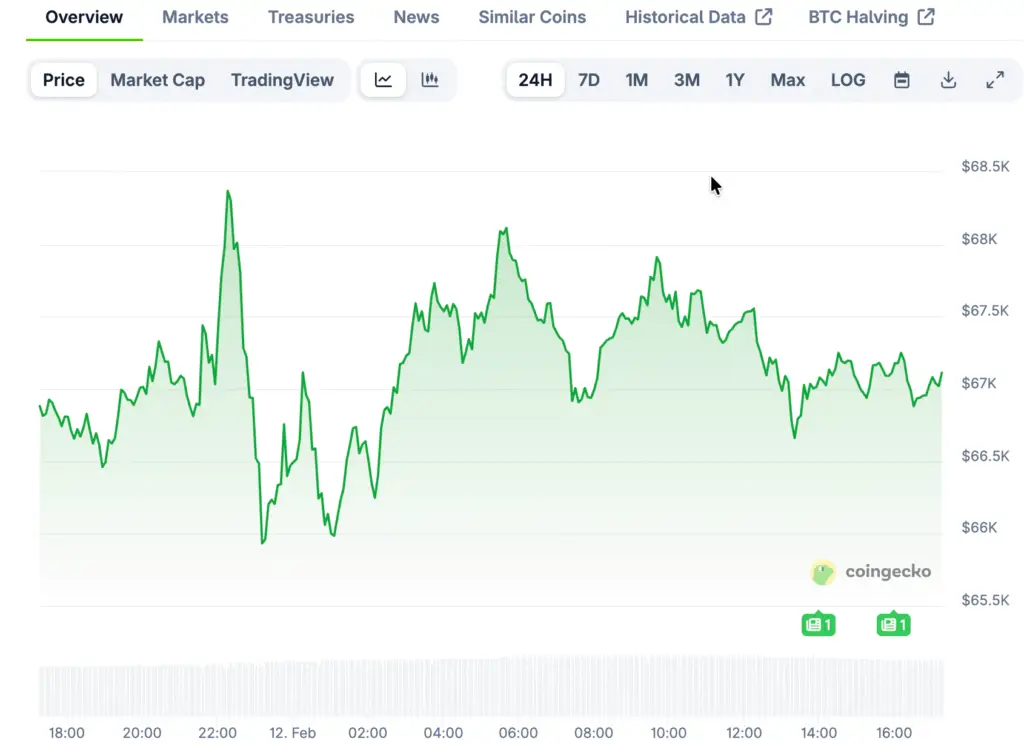
Bitcoin’s recent rise lost steam as the cryptocurrency stayed around $66,000, which shows that there is still a lot of uncertainty in digital asset markets around the world. The token had gone back up to around $70,000 after falling sharply earlier in February, but there wasn’t much follow-through. Traders seem to be cautious now, looking at both macroeconomic signals and technical resistance levels that are stopping a sustained upward breakout.
Bitcoin, the most valuable cryptocurrency in the world, is still well below its October record high of more than $126,000. This shows how quickly sentiment changed after a lot of selling. Over the past month, downward pressure grew stronger as leveraged positions were unwound and the broader financial markets became more volatile again. Bitcoin is still trading in a fairly narrow range of about $66,000 to $72,000, even though it has temporarily stabilized.
Liquidations Amplify Market Downturn and Selling Pressure
The sharp drop in February was made worse by widespread liquidations, which forced traders to close leveraged positions when certain price levels were reached. These automated closures set off a chain reaction that made the downward momentum stronger than what would have happened with just natural spot market selling. Even though liquidation activity has slowed down recently, its effects are still affecting traders’ minds and short-term positioning choices.
These kinds of events show how weak the structure of crypto derivatives markets is, where leverage can quickly turn small drops into big sell-offs. More and more, investors keep an eye on funding rates and open interest metrics to try to predict when volatility will rise before it does. The recent event strengthens calls for careful risk management when there is a lot of speculative exposure.
Technology Stocks and Macro Trends Influence Crypto Direction
Bitcoin often moves in the same direction as high-growth tech stocks, so problems in that sector are especially bad for digital assets. Recent changes in U.S. tech stocks made people less willing to take risks, which led to capital moving away from risky investments. This connection shows that crypto is still very much a part of global liquidity cycles and doesn’t work on its own.
Macroeconomic uncertainty makes things even harder to predict as investors think about how changes in Federal Reserve leadership expectations might affect monetary policy. Policy direction affects the cost of borrowing, the availability of cash, and, in the end, the demand for risky assets like cryptocurrencies. Because of this, bitcoin’s path is more and more like that of traditional financial variables that were once thought to be unimportant in decentralized markets.
Recommended Article: Fidelity Flags $65K Bitcoin As Strategic Entry Amid Market Reset
ETF Flows Create Competing Forces on Bitcoin Prices
Exchange-traded funds that hold bitcoin made things even more complicated by acting as big buyers and sellers who could change how prices moved. Recent outflows from some issuers put more pressure on the market, adding to the bearish momentum that was already present in a weak market. But the last 3 sessions saw net inflows, which suggests that institutions are getting back into the market.
Institutional participation often shows a long-term commitment, but it can also add new volatility depending on how funds are allocated. Market participants now closely watch ETF flow data as a way to see how professional investors feel right now. If inflows keep coming in, they could help keep prices stable. But if withdrawals start up again, they could make corrections last longer.
The Four-Year Halving Cycle is Back in the News for Investors
People are paying attention again to bitcoin’s 4-year cycle, which usually starts with halving events that are built into the cryptocurrency’s underlying protocol. Halvings lower the rewards for miners, which limits the amount of new supply that can enter circulation. They also often happen before big bull market expansions. The most recent halving took place in April 2024, which sparked new debate about whether old patterns still hold true.
Some people wondered if institutionalization and market maturation could make bitcoin’s cyclical behavior less strong than it has been in the past. But many experts say that the structural mechanics behind supply shocks haven’t changed, even though the demographics of people who participate have changed. If history repeats itself, times of excitement may still lead to big corrections.
Analysts Say There Could Be a Drop to $50,000
Several market strategists think that the market will go down even more before it starts to recover, based on what has happened in past cycles. Steven McClurg, the CEO of Canary Capital, thinks that 2026 will be the bearish leg that usually comes after a halving. He thinks that bitcoin could drop to $50,000 in the summer before things get better later in the year.
Markus Thielen from 10X Research had a similar view, which supports the idea that deeper retracements are still possible. These kinds of projections don’t always mean that the structure is weak; they just show that the market is cooling down after big rallies. Because of this, investors must be patient and set realistic goals.
Long-Term Outlook Hinges on Liquidity and Market Confidence
In the end, bitcoin’s direction will probably depend on how much money is available around the world, how committed institutions are, and how long investors stay confident. If the economy stabilizes and capital flows pick up, the cryptocurrency could start to rise again, even though it has been going through a rough patch. On the other hand, tighter financial conditions could make consolidation last longer or start new waves of corrections.
Bitcoin is currently in a transitional phase where different stories affect how people feel about it in both the retail and professional trading communities. Psychologically, support levels close to $60,000 are still important, and resistance above keeps breakout attempts from happening. In the next few months, it may become clearer whether the current pause is a healthy consolidation or the start of another big move.