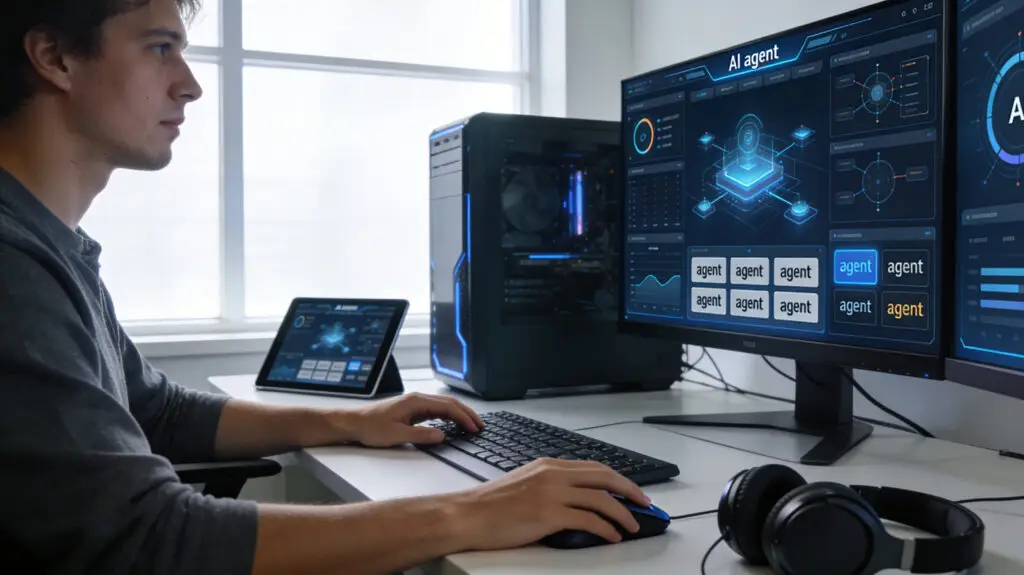
AMD Releases OpenClaw Framework For AI Agents That Work Locally
AMD showed off OpenClaw, a framework that lets advanced AI agents run on personal computers. The system lets developers use large language models without needing cloud infrastructure. AMD thinks this method could change the way people use AI tools.
OpenClaw lets AI models run directly on personal hardware instead of sending data to remote servers. This design helps keep your data private and makes you less dependent on cloud services that charge a monthly fee. AMD sees OpenClaw as part of its larger plan for decentralized AI computing.
Source: AMD
The Agent Computer Initiative Supports AI On Devices
OpenClaw is a part of AMD’s larger Agent Computer project, which is all about AI systems that run on their own. The company thinks that computers of the future will be able to run smart assistants all the time without having to process them remotely. These kinds of systems could let users control their personal information better and get answers faster.
AMD says that many AI tasks don’t need huge cloud data centers to work well. Thanks to improvements in processors and graphics hardware, powerful models can now run on their own. This change could lower latency and make privacy protections better for regular users.
RyzenClaw Configuration Aims For Deep Context Processing
OpenClaw comes with a new hardware configuration called RyzenClaw, which is based on the Ryzen AI Max+ processor. To handle heavy AI workloads locally, the system has 128GB of unified memory. AMD suggests giving about 96GB to variable graphics tasks that help large language model inference.
With advanced language models, this setup can make about 45 tokens every second. During testing, it can handle 10000 tokens in about 19.5 seconds. The 260000-token context window makes it possible for complex multi-agent workflows to happen.
Recommended Article: Tesla Terafab AI Chip Factory Launch Set For March 21
RadeonClaw Configuration Is All About Faster Processing Speed
The second setup, RadeonClaw, moves some of the work that needs to be done to a separate graphics processing unit. The Radeon AI PRO R9700 GPU with 32GB of dedicated video memory is used by this system. The design that focuses on the GPU greatly speeds up large language model operations.
Using the same AI model settings, performance goes up to about 120 tokens per second. In benchmark tests, it takes about 4.4 seconds to process an input of 10000 tokens. This setup, on the other hand, can only handle a few AI agents at the same time compared to the RyzenClaw architecture.
OpenClaw Works With Local Language Models And Memory Systems
OpenClaw operates on Windows systems using the Windows Subsystem for Linux version WSL2 environment. Local inference happens in LM Studio, which uses the llama.cpp backend to process language models. With this setup, developers can run models like Qwen 3.5 35B A3B on their own computers.
The platform also has a memory system called Memory.md that lets you store contextual information on your own computer. This embedding-based framework keeps AI context without using cloud synchronization services. This means that developers can make AI agents that work all the time in local computing environments.
Target Developers And Early Adopters With Hardware Requirements
AMD says that OpenClaw is currently aimed at developers who are trying out different architectures for local AI agents. Powerful processors and a lot of memory are needed for systems that can run RyzenClaw configurations. AMD says that a workstation with Ryzen AI Max+ hardware starts at about $2700.
The RadeonClaw option costs more because the Radeon AI PRO R9700 GPU alone costs $1299. For now, these hardware requirements make the system too expensive for most people. But developers and research teams might find the features useful for testing.
Local AI Computing Could Reshape Future Technology
AMD thinks that OpenClaw is part of a larger trend toward personal computing systems that use AI. If local AI agents become popular, people may not need to use centralized cloud platforms as much. This change could change the way people use and control smart software tools.
AMD wants to connect the power of personal computers with the power of data centers by using powerful processors and advanced AI frameworks. Local AI systems could run all the time and keep user data safe at the same time. These kinds of changes could affect how software ecosystems grow in the future.