



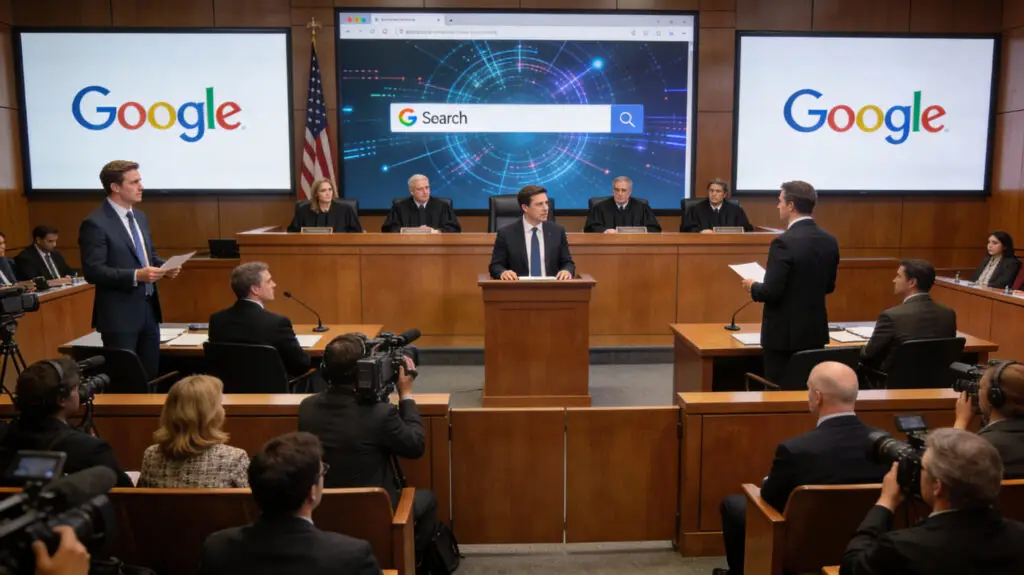
Google Challenges Landmark US Antitrust Ruling On Search Monopoly
Google officially appealed a major US district court decision that said its dominance in online search was against antitrust law. The company says the decision does not accurately reflect what customers want and does not take into account how quickly technology is changing the way businesses compete. Executives say that users choose Google freely, not because of technical or contractual restrictions that force them to.
The appeal is against Judge Amit Mehta’s August decision that Google illegally kept its monopoly power in search markets. Google says the decision did not take into account how much pressure from competitors and new AI powered services would push for innovation. The company said that the appeal was necessary to protect consumer benefits and competition incentives.

Source: Digital Watch Observatory/Website
Company Disputes Findings On Innovation And Competitive Pressure
Google said that the court did not take into account the strong competition from social media apps, AI powered discovery tools, and other specialized apps. Executives say that cycles of innovation move faster than regulatory frameworks can fairly judge who is in charge of the market. They say that strict solutions could freeze markets instead of encouraging real breakthroughs in competition.
The company stressed that it spends billions of dollars each year on research into cloud infrastructure and AI. Google says that these investments show that there is still competition going on, not that there is a monopoly. It says that structural or data sharing mandates should not punish companies that are successful at coming up with new ideas.
Remedies Debate Focuses On Data Sharing And Syndication
Judge Mehta said no to a breakup that would have included forcing the Chrome browser to split off. Instead, he suggested smaller fixes, such as allowing qualified competitors to share data with each other. These steps are meant to make it easier to start a business while still encouraging new ideas.
The ruling says that Google must share parts of its search index and let other sites use its results. Regulators say this could help smaller companies make competing products more quickly. Google says that sharing like this puts security, privacy, and long term product differentiation at risk.
Recommended Article: Avikus Signs Record Autonomous Navigation Deal With HMM Fleet
Google Seeks Pause On Implementing Court Ordered Fixes
Google asked for a temporary stop to the remedies while the appeal moves through higher courts. The business said that following the rules right away could hurt its operations and competition in ways that cannot be fixed. Executives stressed that fixes should wait until an appellate review makes the law clearer.
Mulholland said that forced access to data could still put sensitive user information at risk, even with protections in place. She said that mandates might make it less likely that competitors will invest in independent technologies. Google said that the request for a pause was about protecting consumers and innovation, not about avoiding responsibility.
Privacy And Trust In Consumers Are At The Heart Of The Appeal Arguments
Google said that search data shows very personal information about how users behave and what they want. Even sharing this kind of information with limits could make people less trusting of digital services. The company said that privacy risks would eventually hurt the whole tech ecosystem.
Executives said that customers expect platforms to keep their information safe from being shared without their permission. Google said it was able to balance competition with responsible data management. It said that losing privacy would make healthy market competition weaker, not stronger.
Global Scrutiny Grows As AI Reshapes Search Competition
The appeal comes at a time when more people around the world are looking into Google’s growing AI powered search features. European regulators have recently started looking into AI generated summaries that show up above regular results. The government is looking into whether the way publishers use and pay for content breaks competition rules.
Google said that these kinds of investigations could stifle innovation in very competitive global markets. The company stressed that AI development needs a lot of data and testing. It said that inconsistent regulatory approaches could put domestic companies at a disadvantage compared to international competitors.
Market Dominance Debate Continues As Alphabet Hits Milestone
Google’s parent company, Alphabet, reached a market capitalization of 4 trillion dollars, even though it had to deal with legal issues. The valuation shows that investors are confident that cloud computing and AI will drive long term growth. People who do not like this kind of scale say it makes worries about market power concentration stronger.
The appeal shows that there are still problems between enforcing competition and making new policies. Companies, courts, and regulators are still arguing about how to balance being the best with making progress in technology. The result could change the rules for digital platforms around the world when it comes to antitrust.