Carney Begins Pivotal Visit as Relations Remain Deeply Strained
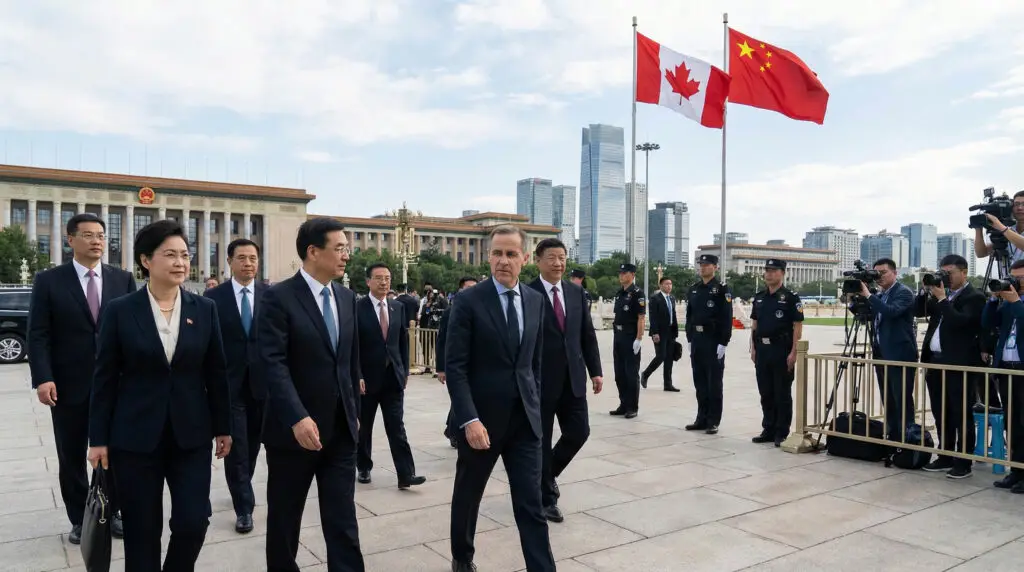
This year, Mark Carney, the Prime Minister of Canada, made his first official trip to China. After almost ten years of political disagreements and trade wars, he wants to start over with diplomatic relations.
Carney is going to Beijing for high-level talks with President Xi Jinping and Premier Li Qiang. Officials say that trade access, investment opportunities, and long-term frameworks for economic cooperation will be the main topics of the meetings.
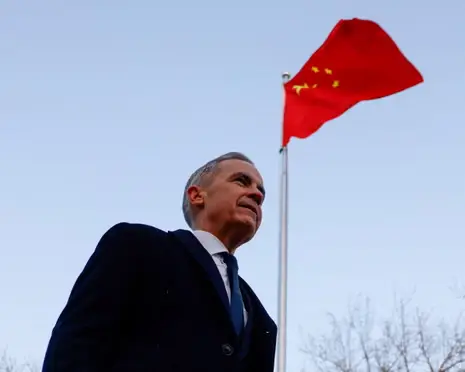
Source: The Guardian
Diplomatic Freeze Followed Huawei Arrest and Retaliatory Detentions
After Canada arrested Huawei executive Meng Wanzhou in Vancouver in December 2018, things got much worse between the two countries. China’s response was to arrest two Canadians, which made things worse and stopped several diplomatic exchanges.
Even though the detainees were released later, mistrust remained and made it hard for governments to work together for several years. Trade continued, but political talks were still cautious and often confrontational in many international forums.
Trade Disputes Intensified Through Electric Vehicle and Agriculture Tariffs
In 2024, Canada put 100% tariffs on Chinese electric cars. Beijing responded by limiting the import of Canadian agricultural goods, such as canola, pork, and other important goods.
Ottawa also said that Beijing was interfering in its own politics, which made trust between the two countries even worse. Chinese officials denied those claims and said Canada was too close to Washington’s geopolitical goals.
Recommended Article: Venezuela Frees Some Political Prisoners as Repression Persists
Diversifying Trade Away From United States Becomes Urgent Priority
Carney has promised to double Canada’s trade with countries other than the United States in the next ten years by aggressively diversifying. Almost 80% of Canadian exports go to the US right now, which makes them vulnerable to changes in policy.
Trump put a general tariff of 35% on all goods, as well as separate duties on steel, aluminum, and lumber. He also kept saying that Canada should become the 51st state of the United States, which scared politicians and investors.
Analysts Describe Visit as Pragmatic Economic Recalibration Effort
Experts say that Carney’s visit is a planned move toward more practical engagement instead of ideological alignment. Officials think that the talks will mostly be about selling Canadian goods that are based on energy, agriculture, and natural resources.
Vina Nadjibulla, the vice president, said that the trip was Carney’s second most difficult diplomatic task. She said that political risks are still high, even though both sides have economic reasons to work together carefully.
USMCA Uncertainty Adds Pressure to Canadian Trade Strategy
The North American trade agreement is still being looked at officially and could be renegotiated every year until 2036. If the agreement isn’t extended, it could lead to long-term policy uncertainty that makes people less confident about investing.
Trump recently called the agreement useless, even though eighty-six percent of Canadian exports meet the current requirements. Experts say that replacing bilateral agreements would raise costs for manufacturers and supply chains that cross borders.
China Also Seeks Political and Strategic Gains From Engagement
Beijing hopes that better ties will make Canada less likely to agree with Washington on important geopolitical issues. Chinese officials want Ottawa to take a less extreme stance on the South China Sea and Taiwan issues.
The fact that Canadian lawmakers left Taiwan early shows that diplomats are being careful before talks begin. Experts say that Canada needs to find a balance between the economic benefits and its commitments to sovereignty and its alliances.
Long-Term Outcome Depends on Economic Results and Political Restraint
Carney’s larger diplomatic tour includes Europe, the Gulf states, and Qatar to find new sources of investment. He says that having a variety of trade networks makes the economy more stable when the world is politically divided.
People who are watching say that both governments need to make real business deals and use measured language for things to go well. If there isn’t ongoing cooperation, symbolic visits alone might not be enough to change years of deep-seated distrust.